
Marketing events to healthcare professionals (HCP’s) is hard in ways most event marketers don’t fully anticipate until they’re already stuck.
You’re trying to reach providers who are treating patients, often not on social media, and subject to compliance rules that limit how you can even talk to them.
Traci Stephenson has been working inside those constraints for years.
As Senior Event Marketing Manager at Henry Schein –the world’s largest provider of healthcare solutions to office-based dental and medical practitioners– she runs THRIVELIVE, the company’s flagship dental convention with over 100 speakers and courses.
In our latest Sevinar, Traci joins Rachel Stephan to walk through the specific tactics her team used to get busy clinicians to show up. Here are nine of them:
1. Treat your sales team like a marketing channel
When your audience is hard to reach through digital, your field reps are the best thing you’ve got. They already have relationships. They’re already walking into dental offices every day.
Traci is direct about where the registrations actually come from:
“What we rely on heavily, at least in this industry, are our sales team, our field sales professionals. They’re going into offices every day, seeing their customers. They have their list of customers that they’re close with. That’s where we see the bulk of our registrations come from.”
Tactic: Build a sales enablement kit with sell sheets, slide decks, pricing guides, tier breakdowns and more. This gives sales reps everything they need to pitch attendance during an office visit without having to improvise.
Whatever you include, make sure it clears compliance review first. If there are restrictions on what can be handed to a clinician, your reps need materials that work within those rules, not around them.
2. Incentivize the sales team, not just the attendee
Getting reps equipped is one problem. Getting them to actually prioritize your event over everything else competing for their attention is another. At a company the size of Henry Schein, the sales team is pulled in a lot of directions.
Traci explains how her team keeps it front of mind:
“We have various incentive programs in place to help drive engagement. For example, hitting specific performance milestones might earn tour Team Schein Members a spot at THRIVELIVE or other professional rewards. Setting these clear targets and timelines really helps keep the team focused on our collective goals.”
Tactic: Create milestone-based incentives tied to registration targets – event attendance or other perks that will keep reps focused throughout the campaign, not just at launch.
3. Acknowledge the practice partners and provide value to them Directly
Many healthcare marketers assume their lists are strictly clinicians, but the reality is that office managers and administrative leads are often the primary touchpoints. Traci notes the importance of recognizing these essential roles:
“Our audience is largely comprised of the professionals who keep the office running and handle the procurement. It’s important to realize that our communications reach the entire team, not just the clinician. We need to be intentional about how we speak to everyone in the practice.”
Tactic: Audit your database to understand the diverse roles within your contact list. Instead of a one-size-fits-all approach, build specialized messaging tracks. Ensure that the administrative team sees the specific value the event brings to their workflow and the practice’s overall success.
4. Empower practice leaders to champion professional development
Once you recognize that office managers and administrative leads are the primary decision-influencers, the goal shifts from simply informing them to empowering them. These professionals are often the biggest advocates for a practice’s growth, but they are also incredibly busy. . Traci’s team did something surprisingly simple.
“We developed a specialized one-pager that outlines the clinical and business value of THRIVELIVE. It’s designed to help office leads easily present the benefits of the event to the rest of the team or the practice owner. It’s about making it as easy as possible for them to say ‘yes’ “.”
Tactic: Create a “convince your boss” one-pager for office leads that covers ROI, learning outcomes, and the business case for attendance, so they can champion the event without starting from scratch
5. Design the event for the whole office, not just the doctor
There’s a bigger opportunity buried in tactic four. If the event has something for the office manager and the hygienist, he administrative and clinical staff become your most motivated advocates.
Traci says:
“THRIVELIVE is an event that has a lot for the team members as well. We have a lot of courses for office managers and hygienists. So there is a motivator for them to also go. A lot of trade shows like this, they’re really only for the doctor — so what’s the motivation for people to communicate?”
Tactic: When scoping your event program, consider building dedicated tracks or sessions for the broader office team. It multiplies your reasons-to-attend and gives administrative staff a personal stake in saying yes. Plus, it can help increase the overall size of your audience.
6. Don’t sleep on direct mail (and physical swag)
Email tends to get forgotten. Traci makes a case for why physical mail (surprise!) still belongs in the mix: it lands in the office where everyone can see it.
“People have kind of strayed from direct mail, but to us it works because it can land in the office. So everybody in the office can see it. We’ve done calendar magnets that will go on the fridge — things that will stay there. We’ve done post-its. We’ll either arm our salespeople with these things to bring in, or we’ll actually just send it directly to the office.”
Tactic: Add a direct mail component or physical swag items to your event promotion mix. Calendar magnets, save-the-date cards, branded desk items that stay visible after an email gets buried. Route them through reps for a warm hand-off, or mail directly to office addresses.
7. Use SMS – for your sales team and your prospects
Clinicians are heads-down with patients all day. SMS gets through in an intimate way that email can’t.
This is also why industry research now points to omnichannel engagement.
According to IQVIA’s HCP engagement trend for 2025:
“Marketers are integrating email with EHR messaging, referral tools, social media, and specialty platforms to create a seamless experience across HCP touchpoints.”
Traci’s approach reflects exactly that: email, SMS, direct mail, and rep outreach working together to improve the odds that your message is seen and acted on.
And SMS isn’t used only to reach out to prospects but also to keep the internal team moving.
Traci says: “We do a lot of SMS to the sales team also. And we even had a service where they could just text us the information for the customer that they wanted to register, and we had someone that was actually doing that and putting that in on the back end.”
Tactic: Run parallel SMS streams – one to prospects with event reminders, one to reps with updates and deadlines. And consider removing friction entirely: let reps text in a customer’s details and handle the registration yourself on the back end.
8. Partner with dental media and third-party lists to reach clinicians directly
While optimizing your current database is essential, reaching the full breadth of the dental team sometimes requires looking beyond your internal lists. For organizations whose primary relationships are with operational leads, strategic partnerships are the key to connecting with the wider clinical community.
“We collaborate with third-party partners because they have deep connections across the entire dental landscape. While our internal lists are incredibly strong with office managers and teams, these partnerships ensure we are also reaching the dentists and clinicians directly.”
Tactic: Find two or three dental media partners or association lists that reach your actual target clinical audience. Co-promote through their channels to get in front of the clinicians your own database can’t reach.
9. Activate speakers, exhibitors, and internal employees as peer-to-peer advocates
When direct reach has limits, you extend it through people whose networks are already full of exactly who you’re trying to reach. Traci’s team built a system around four stakeholder groups, each with their own referral track and tailored incentive.
“We try to tap into the exhibitors that are coming — ‘Hey, my company is exhibiting at THRIVELIVE.’ And even the speakers as well. A lot of people are following them because they want to learn. They know they’re the top people in this industry. And there’s still an untapped market within the Henry Schein ecosystem — even if I posted it to my social, you never know who’s following me, what doctors I’ve met throughout my time that then might see it.”
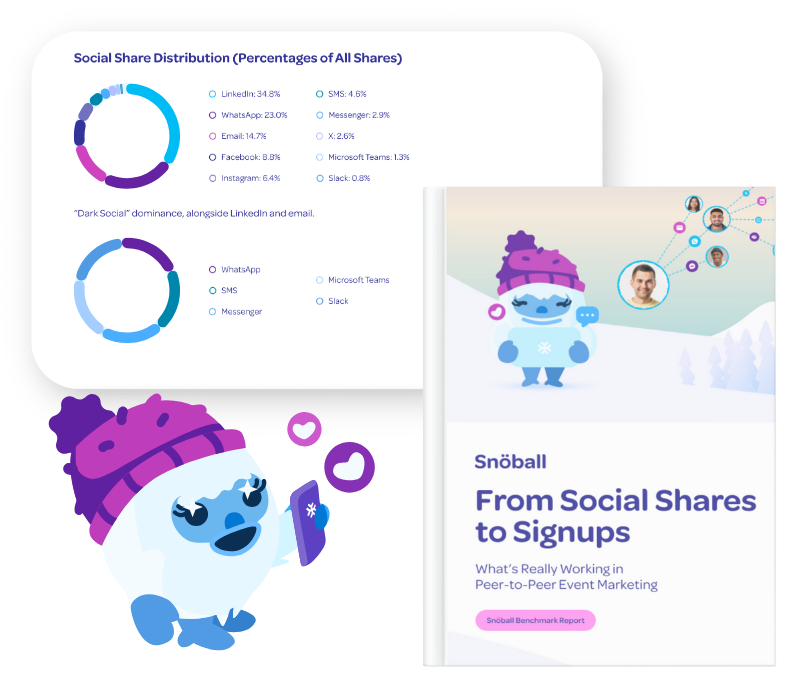
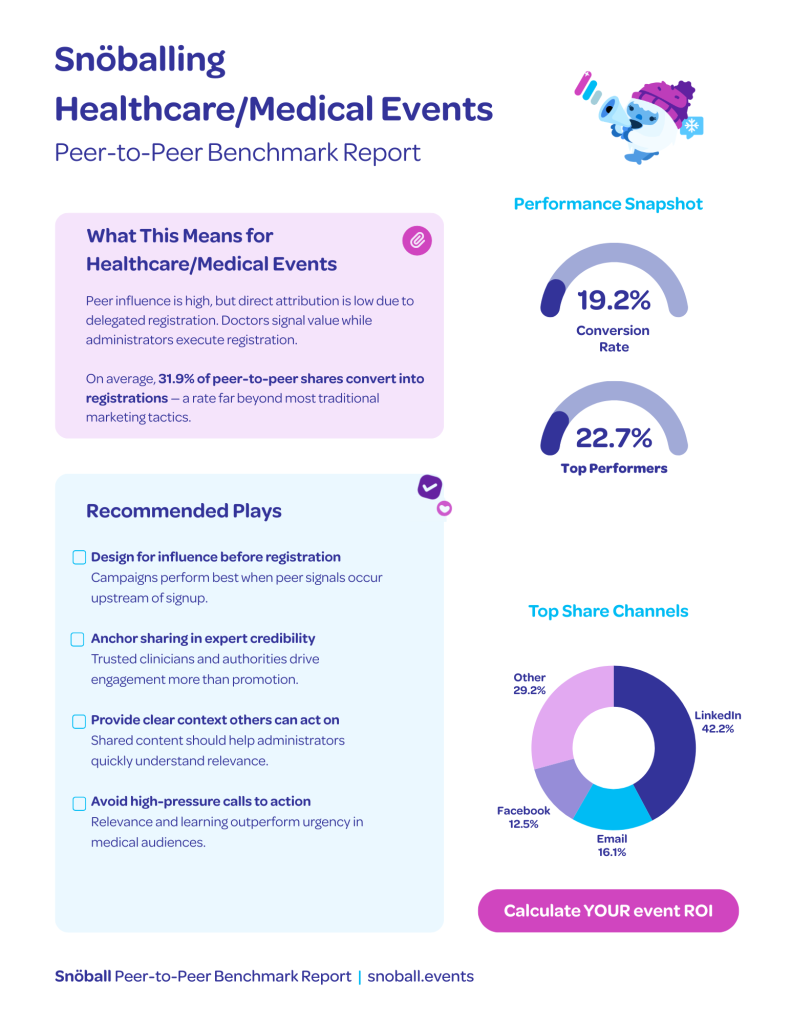
There’s also a reason this tactic lands differently in healthcare than in other industries. Snöball’s 2026 P2P Event Marketing Benchmark Report confirms what earlier tactics in this piece already point to: often in healthcare events doctors influence attendance, and administrators handle sign-ups. Clinicians are motivated by their peers, and your existing structure captures that interest.
For more insights, here’s how HCP-based events performed in peer-to-peer campaigns:
The incentives are calibrated to what each group actually cares about. Exhibitors respond to experiential rewards – THRIVELIVE has hosted entertainment nights headlined by Ray Romano and Kevin James, giving exhibitor advocates something genuinely worth talking about.
Speakers get personal referral links and a natural hook: “I’m speaking — come see me.” Internal employees get access to the event itself, with suite upgrades and celebrity meet-and-greets for top performers.
Tactic: Build a peer-to-peer marketing program with dedicated referral tracks for each stakeholder group. Tailor the incentive to what each group actually values, give them a personal referral link, and make participation as frictionless as possible.
Bottomline
The thing that makes Henry Schein’s approach worth studying is that every tactic has a specific reason to exist. Clinicians are hard to reach digitally, so field reps carry the load.
Since administrative leaders are the primary operational touchpoint, they are treated as essential strategic partners in the communication process. When internal databases lean toward office leads, industry partnerships are leveraged to ensure a balanced outreach. And where personal networks might be underutilized, a structured peer-to-peer program transforms those relationships into a powerful engine for engagement.
In short, here’s what Traci’s team does:
- Treat the sales team as a primary marketing channel
- Incentivize reps with milestone-based rewards tied to registration targets
- Build messaging tracks for office teams
- Equip teams with one-pagers
- Design the event program for the whole office, not just the doctor
- Use direct mail and physical swag that stays visible in the office
- Run parallel SMS streams for both prospects and reps
- Partner with dental media and third-party lists to reach clinicians directly
- Activate speakers, exhibitors, and internal employees as peer-to-peer advocates
These nine tactics form a system built around one reality: you cannot market to healthcare professionals the way you market to any other audience.
To drive peer engagement, extend visibility, and grow registrations for THRIVELIVE, Henry Schein partnered with Snöball’s peer-to-peer event marketing solutions that turn speakers, exhibitors, sponsors, and internal teams into active advocates.
About Traci Stephenson
Traci Stephenson is a senior event and experiential marketing leader with 12+ years of experience driving event-led growth, sponsorship monetization, and integrated campaigns for enterprise and B2B organizations, including Nielsen and Henry Schein. Over her career, she has generated more than $75M in event-driven revenue annually and scaled THRIVELIVE – Henry Schein’s flagship dental convention – to over $39M in annual sales. She specializes in translating brand strategy into high-impact live experiences, with a particular focus on sales alignment, complex event ecosystems, and measurable results in compliance-sensitive industries.
Discover how Snöball helps healthcare event teams activate their speakers, exhibitors, and advocates to drive registrations from the clinical audiences that matter most.