

Event marketing has evolved fast.
From “blast an email and hope” to “algorithm-driven social”, to a more complex reality where influence happens everywhere.
Public feeds, private messages, group chats, and 1:1 conversations.
And through it all, one thing has become clear:
There is a growth channel most event marketers still underutilize. People.
Not platforms. Not tools. People.
Because in a world flooded with AI-generated content and paid noise, peer recommendation cuts through. It reinforces your messaging with trust. It humanizes your brand. And it drives action in ways traditional channels cannot.
Peer-to-peer isn’t replacing your marketing channels, it’s what makes them work better.
Public social vs private messaging is the wrong question
The real question is:
Are you enabling people to share where they already communicate and can you measure what happens next?
Because your audience doesn’t live in one place.
They live across:
- LinkedIn (professional identity)
- WhatsApp (trusted peer groups)
- Slack and Teams (internal influence)
- Email (1:1 recommendations)
- Regional apps (WeChat, LINE, Zalo)
And if you don’t meet them there…they won’t switch channels. They simply won’t share.
The data is clear
According to Nielsen, 92% of consumers trust recommendations from people they know over any form of advertising.
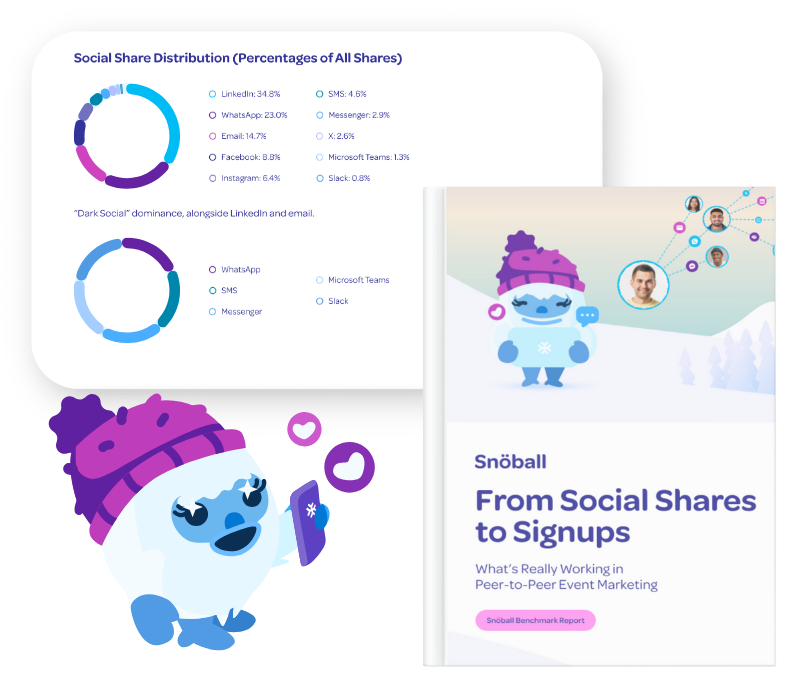
And in the 2026 Snöball Peer-to-Peer Event Marketing Benchmark Report*:
- 31.9% average share-to-registration conversion rate
- 53.7% for top-performing events
- Up to 13.2% of total attendees sourced from P2P
But here’s what most teams miss: that performance depends on channel choice, because behavior is not universal.
Channel behavior changes by role, industry, and region
A VP of Marketing might share publicly on LinkedIn.
A doctor or cybersecurity professional?
They’re far more likely to message peers privately.
A finance team?
They’re inside Microsoft Teams.
An APAC audience?
They’re on WeChat or LINE.
A North American B2B audience?
LinkedIn and email dominate.
Same event, completely different sharing behavior.
And yet, most event platforms still treat sharing like a checkbox: “Here are 3 channels. Good luck.”
Channel choice is a conversion multiplier
When we analyzed thousands of campaigns, one pattern stood out:
Attendees who could share on their preferred channel were 3.2x more likely to actually share.
Think about your own behavior. If you’re asked to “share via email” but you live in Slack…you don’t switch tools. You close the window.
That moment right there?
That’s a lost pipeline.
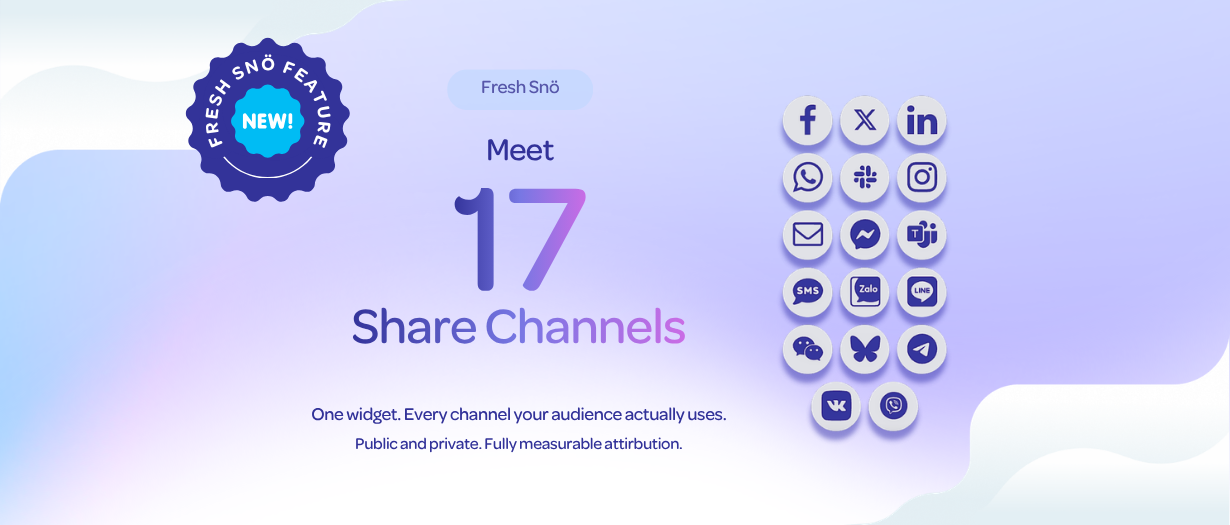
Why Snöball supports 17 channels
Not as a feature, but as a strategy.
Because word-of-mouth doesn’t happen in one place, it happens everywhere people communicate.
And if you want to scale it, you need two things:
- Coverage → let people share where they already are
- Measurement → understand what actually drives registrations
Snöball does both.
Every share, across every channel, becomes:
- Trackable
- Attributable
- Actionable
So you don’t just get more shares…
You learn:
- Which channels convert best
- Which audiences drive growth
- Where to invest (and where to stop spending)
17 sharing channels answer one question: where does your word-of-mouth marketing for events actually happen?
We didn’t pick 17 channels arbitrarily. Each platform serves a distinct audience segment, geographic market, or communication style. Here’s how we think about comprehensive coverage:
The Snöball Strategic Sharing Guide: 17 Channels at a Glance
| Channel | Estimated Reach | Primary Demographics | Best Use Case for Events |
|---|---|---|---|
| 1B+ Users | B2B, Decision-makers, 25-54 | Speaker posts & executive networking. | |
| 3B+ Users | Global, High-trust, 18-65+ | 1:1 peer referrals (High conversion). | |
| 4.5B Users | Professional, Global, All ages | Personalized 1:1 formal invitations. | |
| Slack | 20M+ (B2B) | Tech, Startups, Marketing | Team, Staff, and Exhibitor mobilization. |
| MS Teams | 320M+ Users | Corporate, Enterprise, Govt | Reaching desktop-first corporate workers. |
| 3.07B Users | Broad, 35-65+ (Associations) | Community building & alumni networks. | |
| 3B+ Users | Gen Z, Millennials, Creative | Visual FOMO & speaker takeovers. | |
| X (Twitter) | 500M+ Users | Tech, Journalists, News-seekers | Real-time news & event hashtag buzz. |
| BlueSky | 20M+ Users | Tech, Academic, Early Adopters | Reaching the “New Web” professional. |
| SMS | 6B+ (Global) | Personal, Urgent, All ages | Last-minute sign-ups & urgent alerts. |
| Messenger | 1.3B+ Users | Casual networkers, Family/Friends | Tapping into personal social graph. |
| Telegram | 900M+ Users | Tech, Crypto, Privacy-focused | Large community-led niche event groups. |
| 1.4B+ Users | China, SE Asia, Diaspora | APAC/China-centric event outreach. | |
| LINE | 200M+ Users | Japan, Thailand, Taiwan | Essential for Japan & SE Asia markets. |
| Zalo | 75M+ Users | Vietnam market | Primary B2B channel for Vietnam growth. |
| Viber | 1.1B+ Users | EE, Middle East, Balkans | High penetration in Eastern Europe. |
| VK | 100M+ Users | CIS Region, Eastern Europe | Reaching Russian-speaking delegates. |
Why Each Channel Matters (The Deep Dive)
- LinkedIn: The B2B Trust Engine
LinkedIn is the non-negotiable anchor for professional events. Why? Because sharing there isn’t just about promotion; it’s about professional identity. When a speaker shares their session, they are building their personal brand, which makes them far more likely to engage. For organizers, a single LinkedIn share puts your event in front of a pre-filtered, professional audience. - WhatsApp: The High-Conversion Group Chat
WhatsApp is where the “real” decisions happen. Because it is a private, high-trust environment, a registration link shared in a WhatsApp group of colleagues or industry friends carries 10x the weight of a public post. It’s the ultimate “dark social” channel where conversion happens behind the scenes. - Email: The Personalized 1:1 Invite
Never underestimate the power of a “from-me-to-you” email. Snöball allows advocates to send personalized invitations that look like they came straight from their own inbox. It removes the “corporate blast” feel and replaces it with a genuine peer recommendation. - Slack: The Office Watercooler
For tech and marketing events, Slack is where your audience lives all day. When an attendee drops a “Hey team, I’m heading to this event next month” link into a company or community channel, it sparks immediate internal discussion and group registrations. - Microsoft Teams: The Corporate Portal
Similar to Slack but for the enterprise world. If you are targeting big-name corporate sponsors or government agencies, Teams is the only way to get inside their digital walls. It turns internal advocacy into a scalable growth engine. - Facebook: The Community Hub
While younger crowds move elsewhere, Facebook remains the powerhouse for associations, local chapters, and legacy industries. Its “Groups” feature is a goldmine for peer-to-peer discussion and word-of-mouth advocacy that drives consistent attendance year after year. - Instagram: Visual FOMO & Social Proof
Instagram is where you build the vibe. By letting speakers and attendees share visual templates or “I’m speaking” badges, you’re not just sharing info—you’re sharing the feeling of the event. It’s perfect for driving “Fear Of Missing Out” among creative and millennial audiences. - X (Twitter): The Real-Time Newsroom
X is built for the “now.” It’s where your event hashtag comes to life. It matters because it’s the primary channel for journalists, influencers, and tech enthusiasts to share live updates and breaking news during the lead-up to the event. - BlueSky: The Early Adopter Escape
For the tech and academic crowds moving away from traditional social, BlueSky is the new frontier. Supporting it shows your brand is forward-thinking and meets your community where they are migrating. - SMS: The Direct Path to Action
SMS has a near-100% open rate. It’s the “emergency” sharing channel for last-minute pushes. When an advocate sends an SMS invite, it’s impossible to ignore, making it one of the most effective ways to clear those final registration hurdles. - Messenger: The Personal Connection
Messenger bridges the gap between casual and professional. It allows advocates to tap into their personal social graph—people they might not be connected with on LinkedIn but who share similar professional interests. - Telegram: The Privacy-First Powerhouse
If your event touches on crypto, cybersecurity, or developer communities, Telegram is a must. It’s the default home for niche, privacy-conscious groups that share links and resources at a rapid-fire pace. - WeChat: The Gatekeeper to China
You cannot run a truly global event without WeChat. For attendees and sponsors in the APAC region, it is more than a messaging app—it is their entire digital ecosystem. If you aren’t on WeChat, you’ve effectively locked the door to the Chinese market. - LINE: The Japan & SE Asia Essential
In markets like Japan, Taiwan, and Thailand, LINE is the dominant player. It matters because it’s the primary way people in these regions communicate both personally and professionally. It’s a localized trust builder. - Zalo: The Vietnam Market Leader
Vietnam is a booming market for B2B events, and Zalo is the king there. If you’re looking to grow your footprint in SE Asia, Zalo provides a direct line to Vietnamese professionals who rarely use Western platforms like LinkedIn. - Viber: The Eastern Europe Anchor
Viber is massive in Eastern Europe, the Middle East, and the Balkans. For events with a heavy delegate base in these regions, Viber is the primary peer-to-peer sharing tool, offering a high-penetration alternative to WhatsApp. - VK: The CIS Region Standard
To reach delegates and speakers in Russia and the CIS region, VK is the standard. It ensures your event marketing isn’t geographically limited and that your advocates can reach their local networks effectively.
Geographic coverage is what makes an event referral program work globally (not just at HQ)
Here’s a mistake we see constantly: event organizers design their social sharing strategy around where their headquarters is located, not where their audience actually communicates.
A fintech conference with Asian sponsors cannot rely on LinkedIn and Email. A European association event that ignores WhatsApp is leaving 40-60% of potential peer shares on the table.
The Snöball approach is simple: support the channels your specific audience actually uses, then let the data show you which platforms drive the highest conversion for your particular event type and geographic mix.
Our latest Apex Expo 2025 Case Study data reveals dramatic variation by region: global defaults matter, but regional powerhouses can quietly outperform them in their home markets.
The bottom line: if your share modal does not reflect how your audience already communicates, you are optimizing for your org chart, not your registrations.
The bottom line
Channel choice isn’t a feature, it’s a multiplier.
As noted in PCMA’s 2026 Trends Report, the future of events belongs to organizers who prioritize human-centric connection over digital noise.
Because when you:
- Let people share how they want
- Meet them where they already are
- And measure what actually works
You don’t just get more reach, you get more registrations.