The 2026 Cost Per Registration Guide for Event Marketers
Event marketing guide

2026 Edition

The Cost Per Registration
Guide for Event Marketers

There have never been more ways to fill an event. There have also never been more ways to lose track of what each registration really costs. This guide breaks down every major channel, what they cost in 2026, and where the hidden spend hides.

13 sections 8 channels compared ~12 min read

The short version

Where each channel lands on cost

CPR varies by event type, audience, geography, and how well a channel is run. Treat this as a directional map, not a fixed target. Hover or tap a channel to see why it sits where it does.

Lower cost per registration Higher cost per registration
Tap a channel above AI search sits outside this scale for now. There is no accepted CPR benchmark yet, so most teams treat it as part of SEO and content.

01 / The pressure

Why registration costs keep rising

For years, event teams could lean on a familiar playbook of paid search, paid social, email, content, and partner promotion. Those channels still matter, but the economics behind them are shifting, and 2026 is no exception.

Budgets are tighter while paid acquisition keeps getting more expensive. At the same time, the registration journey now runs through more touchpoints than most reporting can capture, which makes it harder to know what is actually working.

7.7%

of revenue is the average marketing budget, down from 9.5% three years ago. 59% of CMOs say they lack the budget to execute their strategy.

Gartner 2025 CMO Spend Survey

$2.96

average Google Ads CPC in Q1 2026, up 12% on the same period a year earlier. Facebook cost per lead rose 21% to $27.66.

WordStream, 2026

18%

of B2B marketers use integrated cross-channel attribution, even as registrations are shaped by more channels than ever.

RevSure, 2025

A single prospect might find an event through Google, see a LinkedIn post, open an email, ask an AI assistant for recommendations, then register after a colleague shares it in a WhatsApp group. Which channel gets the credit? Answering that means looking past media spend to staff time, agency fees, content, technology, speaker activation, and referral programs. Understanding those costs, and how they vary, is becoming one of the most important skills in event marketing.

02 / The definitions

What cost per registration means in 2026

Three terms show up constantly in event reporting and often get used interchangeably. Each measures something different.

Cost Per Registration

CPR

The total spent to acquire one confirmed signup through a specific channel. This is the metric used throughout the guide.

Total channel spend divided by Registrations from that channel

Total spend should include media, platform and tool fees, creative, agency or freelance fees, and a realistic estimate of staff time. Most published benchmarks only count media, so a complete figure usually runs higher.

Cost Per Acquisition

CPA

A broader term covering any defined conversion: a purchase, a trial, a demo, a subscription, or a registration.

CPR is CPA applied specifically to registrations. Every CPR is a CPA. Not every CPA is a CPR. Benchmarks from other industries cannot be compared directly.

Cost Per Attendee

CPA*

What it costs per person who actually shows up, not just the person who registers.

Every event sees some drop-off between signup and show-up. Where attendance is the real success metric, track both numbers for the full picture.

03 / The new question

What does a registration from AI search cost?

Until recently there were two search channels: paid and organic. Now there is a third. Professionals increasingly use ChatGPT, Perplexity, Gemini, Claude, and Google's AI Overviews to research vendors and discover events. If your event shows up in the answer, AI has joined your acquisition funnel.

58%

drop in click-through to top-ranking pages when Google shows an AI Overview. Visibility now happens inside the answer.

Ahrefs

206%

growth in outbound referral traffic from ChatGPT to the web across 2025. AI-assisted discovery is now measurable.

Semrush

There is no media spend behind an AI recommendation and often no clear click to measure. The investment sits in the assets that make an event discoverable: original research, speaker thought leadership, strong event content, brand mentions in trusted publications, structured event information, and solid organic visibility. Like dark social, the influence is real but the path to conversion is hard to see, so most teams cannot yet calculate a precise AI Search CPR.

Reality check

There is no accepted industry benchmark for AI Search CPR. The question is shifting from "how do we rank in search?" to "how do we become one of the events AI systems recommend?" For now, treat AI visibility as an extension of SEO, content, thought leadership, and digital PR.

04 / The full comparison

Every channel at a glance

One useful anchor before the detail: the average cost per lead at trade shows is $112, against $259 for a field sales call. Even the pricier event channels compare well to direct sales.

ChannelRelative CPRMain strengthMain consideration
Paid search Medium to high Captures active, high-intent demand CPC rises sharply during peak campaign weeks
Paid social: LinkedIn High Precise targeting by title, seniority, and industry Higher per-registration cost; ongoing creative investment
Paid social: Meta Medium Broad reach at lower CPM Less precise for senior B2B; costs rising year on year
Email marketing Low to medium Strong conversion from warm audiences List acquisition cost is often left out of CPR
SEO and content Low over time Highest organic close rate; value compounds 6 to 12 months to rank; limited in short windows
AI search and LLM discovery Emerging Influences discovery through AI recommendations Attribution is hard; no established benchmarks yet
Speaker and exhibitor advocacy Most efficient Peer-to-peer reach through your most trusted voices Needs structured activation and tracked links
Peer-to-peer referral Most efficient 31.9% share-to-registration; fee replaces media spend Attribution needs dedicated infrastructure

05 / Channel by channel

The detail behind each channel

CPR ranges below are directional. The most useful benchmark is almost always your own historical performance, tracked the same way across event cycles.

Paid search

Medium to high

Paid search still captures existing demand better than almost anything. A search for a specific conference signals intent that other channels take time to build. While AI search changes discovery, paid search reaches people who are already looking and ready to act.

Typical cost Google Ads CPC averaged $2.96 in Q1 2026. Business Services runs around $103 per lead, Technology around $133.
Watch for CPC climbs as deadlines approach and sponsors compete for the same keywords. Agency or in-house management adds 10 to 20% on top of media.

Paid social: LinkedIn

High

You pay for precision. Job title, seniority, company size, industry, and function combine into a single audience build, which suits B2B events well. Lead Gen Forms auto-fill from profile data and convert near 13%, against roughly 4% for an external landing page.

Realistic CPR $80 to $200 for broad professional audiences, $150 to $300-plus for senior decision-makers.
Watch for Creative needs regular refresh to avoid fatigue. That production cost belongs in the CPR.

Paid social: Meta

Medium

For consumer events, community gatherings, and regional conferences with broad appeal, Meta offers real cost efficiency. For senior B2B audiences, targeting is less precise, so more spend reaches people outside the intended profile.

Realistic CPR $20 to $55 for consumer and community events, $50 to $120 for B2B with full creative and optimization included.
Watch for Cost per lead rose 21% year on year. Privacy changes continue to make targeting and attribution harder.

Email marketing

Low to medium

For teams with a maintained database, there is no media auction and no minimum spend. Email reaches people who already know the brand, so it consistently delivers favorable CPR. Reported ROI sits between $36 and $42 for every $1 spent.

Realistic CPR $15 to $50 per registration for teams with healthy lists, including platform fees and staff time.
Watch for List building, hygiene, deliverability, and platform fees that scale with list size all belong in the full cost.

SEO and content

Low over time

SEO-generated leads close at 14.6%, against 1.7% for outbound, because the intent is already there. The catch is timing: new content takes 6 to 12 months to rank, well beyond most campaign windows.

Where the value lives Speaker profiles, listings, research, and category pages pull traffic year-round and feed AI discovery too.
Watch for It looks expensive early because content costs land before traffic. Over multiple cycles, CPR drops as costs spread across more registrations.

Speaker and exhibitor advocacy

Most efficient

This is peer-to-peer through your highest-credibility voices. Speakers, exhibitors, and sponsors bring instant trust with an audience that already knows them, and most are happy to promote. The gap between willingness and consistent promotion is usually a process problem, not a motivation one.

Proof point At APEX EXPO 2025, 105 speakers and 983 exhibitors drove 731 referral calls-to-action and a 26.81% conversion rate. FABTECH 2025 hit 26.14%.
Watch for Costs come from briefs, assets, coordination, and tracking, not ad spend, so they do not climb with every extra registration.

Peer-to-peer referral

Often most efficient

Peer-to-peer works differently from every other channel here. Your advocates are your speakers, exhibitors, sponsors, and past attendees, and each gets a personal referral link and ready-to-share content. Cost does not scale with reach, and conversion runs higher because the mechanism is trust, not targeting.

Why it converts 88% of people trust recommendations from someone they know over any advertising. Peer campaigns convert at 31.9% share-to-registration, against 4 to 7% for Google Ads search.
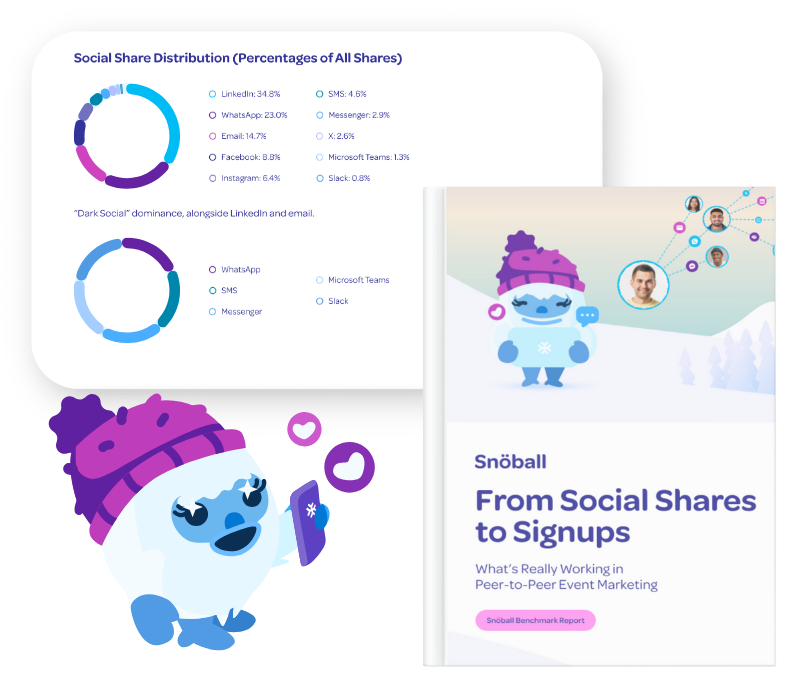
The hidden upside 32.6% of peer shares happen in dark social like WhatsApp, private Slack, and DMs, so the measured contribution often understates the real influence. At HumanX 2025, 5,057 advocates drove a reported 196X ROI.

06 / Matching channel to goal

The lowest CPR is not always the right one

CPR tells you what a registration cost. Registrant quality tells you what it was worth. For executive conferences, hosted buyer events, and premium-ticket events, fit and seniority often matter more than raw volume. The better question is which channel fits the goal in front of you.

Reach high-intent audiences quicklyPaid search
Build long-term discovery and organic visibilitySEO and content
Re-engage past attendees and known contactsEmail
Grow registrations through trusted networks and industry voicesPeer-to-peer (speakers, exhibitors, attendees)
Reach broad audiences at scalePaid social

07 / Putting it together

What an effective mix looks like

No single channel covers everything. Paid channels create immediate visibility. Email re-engages existing audiences. SEO and AI discovery build long-term reach. Speakers, exhibitors, and peer advocates extend reach through trusted relationships. The strongest programs balance reach, efficiency, and attendee quality. As you plan your next event:

  1. 1Calculate CPR at the channel level using the full cost formula, not media spend alone.
  2. 2Compare CPR against registrant quality, not registration volume.
  3. 3Invest more in the channels that deliver both efficient acquisition and valuable attendees.

08 / Questions

CPR, answered quickly

What is cost per registration?

The total cost of acquiring one confirmed registration through a specific channel. Divide total channel spend by registrations attributed to that channel.

What is the difference between CPR and CPA?

CPA measures the cost of any conversion, like a purchase or demo request. CPR is the event-specific version and counts only confirmed registrations.

What is the difference between CPR and cost per attendee?

CPR measures the cost of a registration. Cost per attendee measures the cost of someone who actually attends. Cost per attendee is usually higher and worth tracking separately.

Which channel has the lowest CPR?

For warm, owned audiences, email often wins. For active acquisition, peer-to-peer referral is among the most efficient. The right answer depends on your audience, event type, and database.

Why are LinkedIn registrations expensive?

The cost reflects the targeting. You can reach people by title, seniority, industry, company size, and function, which is valuable when attendee quality matters more than volume.

How do I calculate CPR by channel?

Add up every channel cost, including media, platform fees, creative, agency fees, and staff time. Divide that by the registrations attributed to the channel.

Can I measure registrations from AI search?

Often the discovery happens before any click or identifiable source appears in analytics. Most teams currently fold AI visibility into their SEO, content, and thought leadership efforts.

What is dark social in event marketing?

Sharing that happens in private channels like WhatsApp, direct email, Slack groups, and DMs. It influences registrations but is usually invisible to standard analytics.

Why does peer-to-peer convert better than paid channels?

Because the recommendation comes from someone the recipient already trusts. A colleague, speaker, or peer carries more credibility than brand advertising alone.

Put the formula to work

Apply the CPR formula to your most recent event. Measure every channel the same way, weigh CPR against registrant quality, and let that guide your next budget. The strongest programs pair efficient acquisition with high-value attendees.

Try the P2P ROI calculator

About Snöball

Snöball helps event organizers and associations turn their audiences into their #1 growth channel through peer-to-peer referral marketing. By activating speakers, exhibitors, attendees, and members as advocates across 17+ social channels including WhatsApp, Snöball campaigns convert shares to sign-ups at an average rate of 31.9%, delivering measurable ROI on event marketing spend.

Scroll to Top
Peer to Peer Marketing Benchmark Report 2026

Get the latest P2P Report

What’s Really Working in 
Peer-to-Peer Event Marketing​