Turn Your Speakers Into Your Highest-Trust Marketing Channel
The behavioral-science playbook for getting speakers to actually promote your event — with the real numbers to prove it works.
Event marketers have never had more ways to reach people — and never had a harder time earning their attention. The organizations that win the next few years won’t be the ones shouting loudest. They’ll be the ones whose message arrives through a voice the audience already trusts.
For almost every event, that voice is already on the roster. Your speakers have spent years building credibility in the exact community you’re trying to fill a room with, and their networks usually dwarf your event’s owned channels. The data on why that matters is unambiguous:
Yet most events barely tap it. Speakers get one or two generic “please share” emails, a couple post, most intend to, and the opportunity quietly evaporates. This guide explains exactly why that happens — it’s not the reason most organizers think — and gives you an evidence-based system to fix it.
Why willing speakers still don’t promote your event
Here’s the counterintuitive part: it’s almost never motivation. Most speakers already want the event to succeed — they accepted the invite, they’re prepping their session, they’re proud to be involved. When they don’t post, it’s not apathy. Promotion just lost out to client work, travel, and a full inbox.
Behavioral science calls this the intention–behavior gap. Ajzen’s Theory of Planned Behavior showed that intention predicts action, but rarely closes the gap on its own.
A workplace study by researchers Paschal Sheeran and Michael Silverman confirmed this. They tracked whether employees who intended to attend a training session actually showed up, verified against company records rather than self-reports. Employees who were simply asked about their intention showed low turnout. Employees who were given a moment to plan exactly when and how they’d get there attended at roughly double the rate.
Piling on reminders aims at the wrong target. The issue is rarely enthusiasm. It is design. BJ Fogg’s model explains: behavior happens when motivation, ability, and a prompt line up at once. Most programs max out motivation and prompts while leaving ability unaddressed. Make sharing effortless instead, and participation climbs without a single extra reminder.
What actually motivates a speaker to share
Every share is a small identity decision: Is this worth my reputation? Will my audience value it? Does this reflect well on me? Get those answers right and advocacy becomes natural. Five drivers do most of the work.
People share things that reinforce who they are professionally. Advocacy gets easier when the event is one they’re genuinely proud to be associated with.
Sharing builds a speaker’s visibility, brand, and audience — not just your registrations. When value flows both ways, it stops feeling like a favor.
Self-Determination Theory: let speakers use their own voice, feel capable, and feel part of a community — not a marketing list.
Speakers carry credibility you can’t manufacture. Every recommendation lends the event a piece of it.
A thank-you, a spotlight, or proof of impact sustains advocacy better than gift cards, which make it feel transactional.
The framework: advocacy is a journey, not a campaign
The single biggest structural mistake is treating advocacy as one email. What actually works is a designed journey that gives speakers a fresh, timely reason to engage at every stage.
Start the moment they say “yes”
Confirmation is peak enthusiasm — and the most wasted window. Make “announce your participation” part of onboarding, with a personalized hub ready on day one.
Give them something new to say at each milestone
Advocacy stalls when you ask speakers to repeat the same post. Every milestone — agenda, keynote, early-bird, app launch — is a fresh conversation.
Support every channel, not just LinkedIn
Newsletters, private Slack and WhatsApp groups, podcasts, association forums. Meet advocacy where trusted relationships already live.
Encourage live advocacy
The event produces the most authentic content there is — credible precisely because it isn’t manufactured, and powerful proof for everyone who couldn’t attend.
Extend past the closing keynote
Post-event, speakers share takeaways, recordings, and slides — keeping visibility warm until next year. Think year-round communities, not annual campaigns.
The playbook: the highest-leverage moves
Our full guide details 30 tactics across six themes. Here are the ones that move the needle most.
Reduce friction (do this first)
- One hub for everything: referral link, ready-to-use posts, graphics, copy, and video in a single place, so speakers share instead of search.
- Never a blank page. Provide several drafts they can personalize — the endowment effect means a pre-filled draft already feels like theirs.
- Personalize the asset. A generic banner promotes the event; a page with the speaker’s photo, bio, and link promotes their participation.
- Design for busy pros: mobile-first, one-click sharing, fast load, no logins.
Increase motivation
- Make mutual value explicit. Swap “Please help us promote” for “Invite your community into a conversation you’re leading.”
- Close the loop on results. When a referral converts, you can trace that registration back to the advocate and channel that drove it — sharing that back (an organizer can surface it from the dashboard) is a strong motivator.
- Recognize participation, not just top performers — celebrate first shares, consistency, and creativity.
- Build their brand, not yours. Lead with expertise so the invite continues their narrative instead of interrupting it.
Perfect the timing
Anchor asks to real milestones, replace reminders with contextual prompts, favor consistency over one big push, and end every action with the next one. A milestone-to-advocacy calendar makes it operational:
| Event milestone | Prompt to send | Speaker’s angle |
|---|---|---|
| Speaker confirmed | Announce you’re speaking (personalized page) | “Excited to be joining…” |
| Agenda published | Your session is live — here’s your graphic | “Here’s what I’ll be covering…” |
| Keynote announced | Share the lineup | “Look who I’ll share the stage with…” |
| Early-bird closing | Invite your audience before pricing ends | “Last chance for the best rate…” |
| Event week | Go behind the scenes / live moments | “On my way — come find me at…” |
| Post-event | Share takeaways, slides, recording | “Biggest lesson from my session…” |
Create content speakers actually want to share
Most programs don’t lack content — they lack shareable content. Lead with expertise over promotion (a surprising stat, a lesson learned, a provocative question), offer multiple formats because professionals communicate differently, and provide inspiration rather than rigid scripts so authenticity survives.
The expert playbook: turn a session into pipeline
Speaker advocacy isn’t only about filling seats — the best speakers turn a single session into real business, which is exactly why they’re motivated to promote it. In Snöball’s Sevinar, Mason Cosby broke down how he does it, and it’s a masterclass worth handing to your own speakers.
His method is a simple 4D framework that turns aimless networking into strategic connection:
Who they’re targeting and why — the “targets” and “triggers.” e.g. attendees interested in the topic who haven’t signed up for the session yet.
The best channels to reach those attendees — the event app, an online community, a personal message.
Where to send interested people next — a podcast, newsletter, or content hub they’ll want to return to.
How success is measured — session registrations, attendance, meetings booked, and conversions months later.
Four more moves from the episode worth passing to every speaker:
“My primary goal before my session is not to sell people or book meetings, but to get people to the session. Let’s get them in the door.”
“LinkedIn is public. Email is private. If you shoot them an email, you’re selling.” Keep early outreach on the low-pressure channel.
“If there’s nowhere to send them… that’s a hard road.” A podcast or content hub beats “come meet us and we’ll sell you.”
Hand attendees a template: “Go do these things tonight — it’ll take 30 minutes — then grab us tomorrow and we’ll review it live.”
The payoff for leading with value instead of a pitch? A single 30-minute session became 30 booked meetings and 15 new clients — the result behind the number below.
Proof: what this looks like at scale
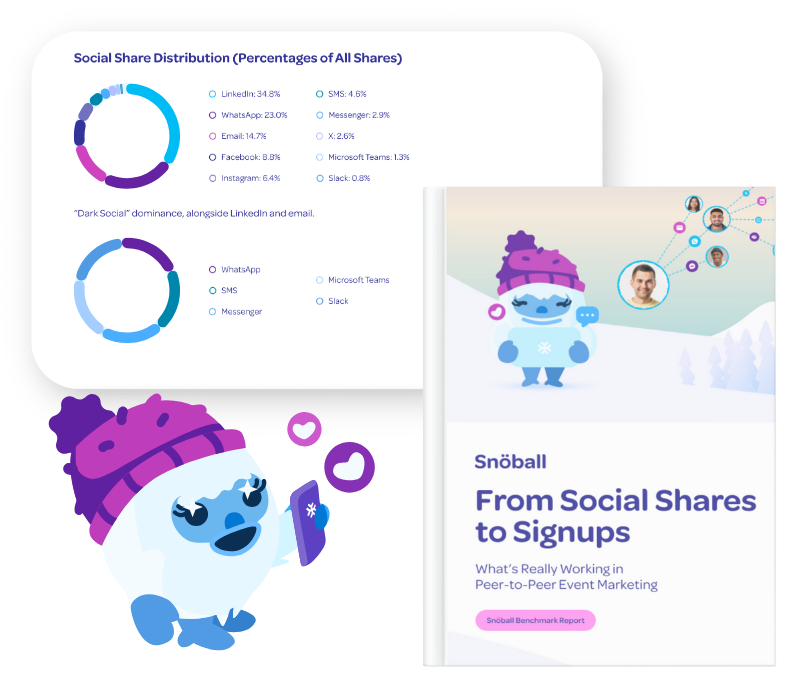
This isn’t theory. Snöball’s benchmark research finds community-led campaigns deliver:
And in the field, across some of the largest events in the world:
Common mistakes that sink advocacy programs
- Treating advocacy as an afterthought instead of building it into onboarding.
- Overwhelming speakers with a pile of assets instead of one simple hub.
- Assuming everyone lives on LinkedIn.
- Ignoring attribution — treating registrations as one anonymous total instead of tracing each back to the advocate and channel that drove it.
- Forgetting to recognize contributors once the event ends.
Where speaker advocacy is headed
AI will keep lowering the effort of creating and personalizing assets — but it won’t replace authenticity, and audiences will keep rewarding real voices over polished corporate messaging. Personalization becomes the baseline, advocacy grows more community-led, and success is increasingly measured by influence — who was reached by a trusted voice — rather than raw reach.
Frequently asked questions
Why don’t speakers promote events even when they want to?
How many speakers will actually promote the event?
Should I pay speakers to promote the event?
When should speaker advocacy start?
What’s the single highest-impact change I can make?
Get the complete Speaker Advocacy playbook
The full 30-tactic system, the behavioral-science foundations, and the milestone templates our team uses across HumanX, FABTECH, G2E and more.