
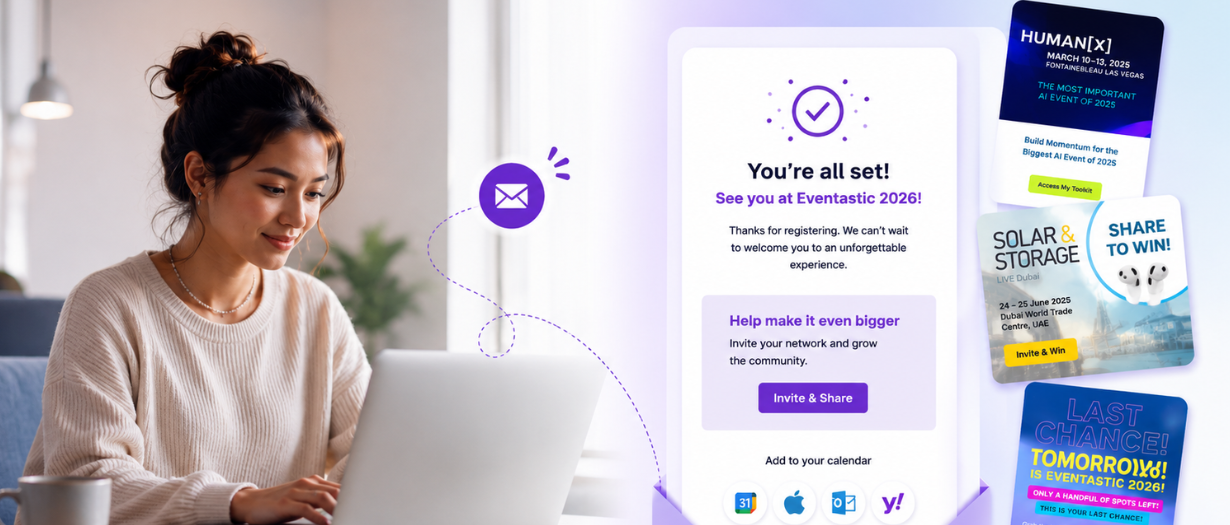
You worked hard to get that registration. Paid ads, email campaigns, social posts, maybe even a speaker shoutout or two. And then someone finally clicks “Register.”
So what do they get?
“Thanks for registering. Here are your event details. Add to calendar.”
A digital receipt. The kind of email you file away and forget.
Here is the thing: the moment someone registers for your event is the most enthusiastic they will likely ever be before they walk through the door. They just made a decision. They are excited. They want to tell people. And you just sent them a timestamp and a location pin.
The confirmation email is one of the highest-performing assets in your entire event marketing stack. People definitely open and read it. It reaches your audience at exactly the right moment, and the registrants want to see if there’s any other information that’s being shared. You need to capitalize that moment and strike when the excitement is red hot. But how?
This article tells you how to change that. Here’s what all you will read:
- The Most-Opened Email You Are Probably Underusing
- The Psychology Behind the Registration Moment
- What Most Confirmation Emails Look Like (And What’s Missing)
- It’s Not Just Attendees. Activate Everyone.
- What to Actually Add to Your Confirmation Email
- Keep the Momentum Going with Booster and Reminder Emails
- How to Know If It’s Working
The Most-Opened Email You Are Probably Underusing
Your newsletter competes with dozens of others in a crowded inbox. Your promotional blast lands alongside offers, alerts, and content people never asked for. Your event confirmation email is different. People open it because they want to. They just registered and they need the details. That intent is built in.
The data backs this up. Brevo’s 2026 email marketing benchmark, drawn from over 175,000 active customers, shows that transactional emails average a 30.63% open rate and a 7.39% click-through rate. Standard marketing emails average a 20.73% open rate and a 2.27% CTR. Salesforce’s benchmarks show transactional emails regularly hit click-to-open rates above 30%, compared to the 6.81% average for emails tracked by MailerLite across 3.6 million campaigns.
The gap exists because the confirmation email reaches someone at a specific moment of intent. They just signed up and they want the details. That is a different reader in a different frame of mind.
Most event confirmation emails stop at the functional minimum: date, time, location, calendar link. Those details matter. But they leave a lot on the table. The excitement, the social energy, the peer influence, the advocacy potential, all of it sits untapped in an email that already has the reader’s full attention.
The Psychology Behind the Registration Moment
Think about the last time you signed up for something you were genuinely excited about. A conference in your field. A workshop with a speaker you had wanted to see for years. A summit your colleagues kept talking about.
The moment you hit “Register,” something shifted. The decision was made. The anticipation kicked in. And almost immediately, you wanted to tell someone.
Research on consumer behavior shows that anticipatory emotions, the kind triggered by committing to an experience, drive action at a disproportionate rate. People in that state are primed to share.
They want to signal their decision to their network. They want validation. They want others to join them.
For event marketers, that moment is a window. And it closes fast.
Within minutes of registering, your new attendee is back in their inbox, their LinkedIn feed, their WhatsApp chats. The excitement is still there, but now it has no outlet.
If you give them a share button, a referral link, a pre-written post, that energy has somewhere to go. Without those tools, the moment passes. The receipt sits in their inbox. The network they could have reached never hears about your event.
Google figured this out a long time ago. When you add an event to Google Calendar, the very next prompt is: “Invite others.” Right then, while the intent is fresh and the action is easy.
That is the model. Meet people at the peak of their enthusiasm, remove the friction, and give them the tools to spread the word.
The confirmation email lands at exactly the right moment. The registrant is warm, willing, and ready to share. What it does with that moment is entirely up to you.
What Most Confirmation Emails Look Like (And What’s Missing)
Open any inbox. Find the last event confirmation you received. Chances are it has some version of the same elements: a thank you line, the event name, the date, the time, the location or access link, and a button to add it to your calendar.
That covers the job. The registrant knows where to be and when. Functionally, the email works.
But look at what is absent.
There is no invitation to share. No pre-written social post. No referral link. No nudge to tell a colleague. No reason to do anything other than save the email and move on.
The Canva Create confirmation email is a useful contrast. It opens with a bold visual, puts the event name front and center, and immediately gives the registrant five calendar options across Google, Apple, Outlook, Microsoft, and Yahoo. That friction has been removed completely. You land on the email and the next step is obvious.
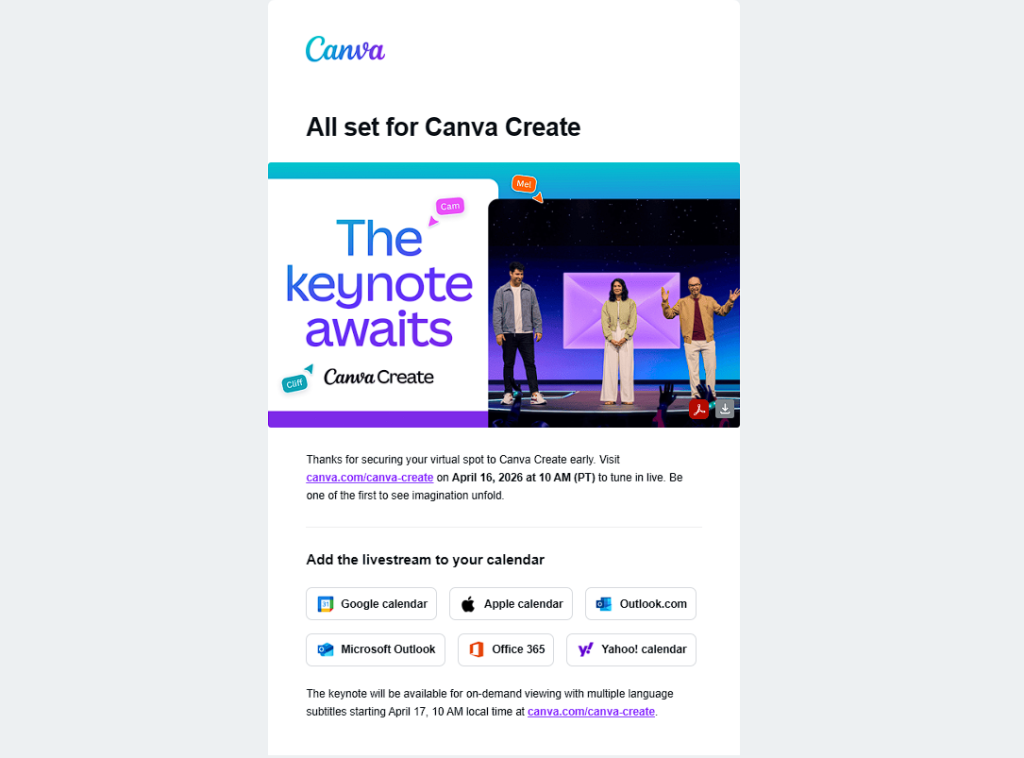
That is a step in the right direction. But even here, the sharing piece is absent. There is no prompt to invite a colleague, no one-click social share, no referral hook. The registrant’s enthusiasm is acknowledged through good design. It is just not channeled into action.
This is the gap most event confirmation emails leave open. They confirm. They do not amplify. And because the confirmation email is the first thing a new registrant reads, it sets the tone for everything that follows. A transactional email signals a transactional relationship. A marketing asset signals something worth being part of and worth sharing.
The fix is simpler than most organizers expect. It comes down to adding the right elements at the right moment, which is exactly what the next section covers.
It’s Not Just Attendees. Activate Everyone.
Most event marketers think about the confirmation email as an attendee communication. Someone registers, they get a confirmation, done. But your attendee list is only one part of your audience. Speakers, exhibitors, and sponsors register too. And each of them brings a different kind of excitement to the table.
Speakers just got confirmed to present in front of their professional peers. That is a credibility moment. They want their network to know. A confirmation email that gives them a ready-made LinkedIn post or a shareable announcement takes thirty seconds to act on. Give them the asset and most will use it.
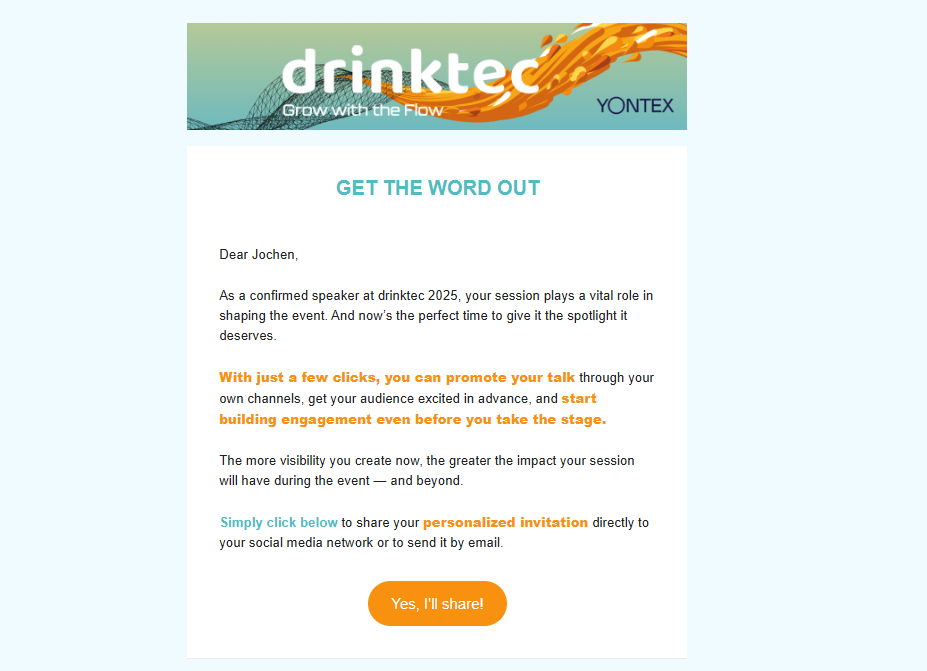
Exhibitors have a business reason to tell their network they will be at the event. They want their customers and prospects to know where to find them. A confirmation email with a pre-built “come visit us at [Event Name]” asset, already branded and ready to share, is something they will actually use. For example, below is an example of an invite that an event organizer or marketer can send to their exhibitors.
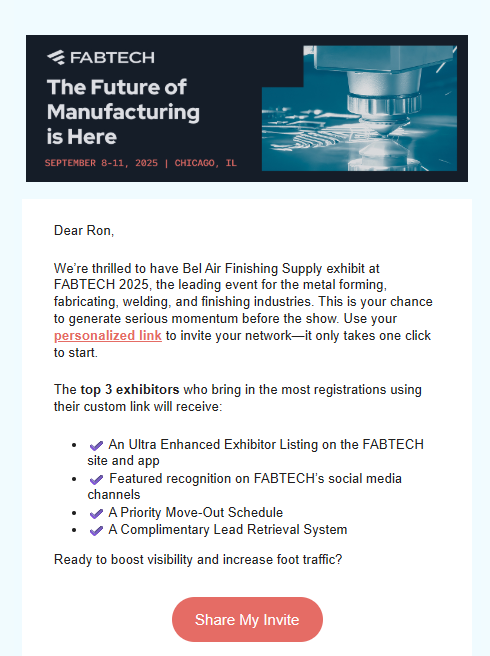
Sponsors have invested in visibility. The confirmation moment is an early opportunity to activate that investment. Give them something to share and they become part of your promotional push from day one, long before the event floor opens. Adding incentives to share can sweeten the deal.
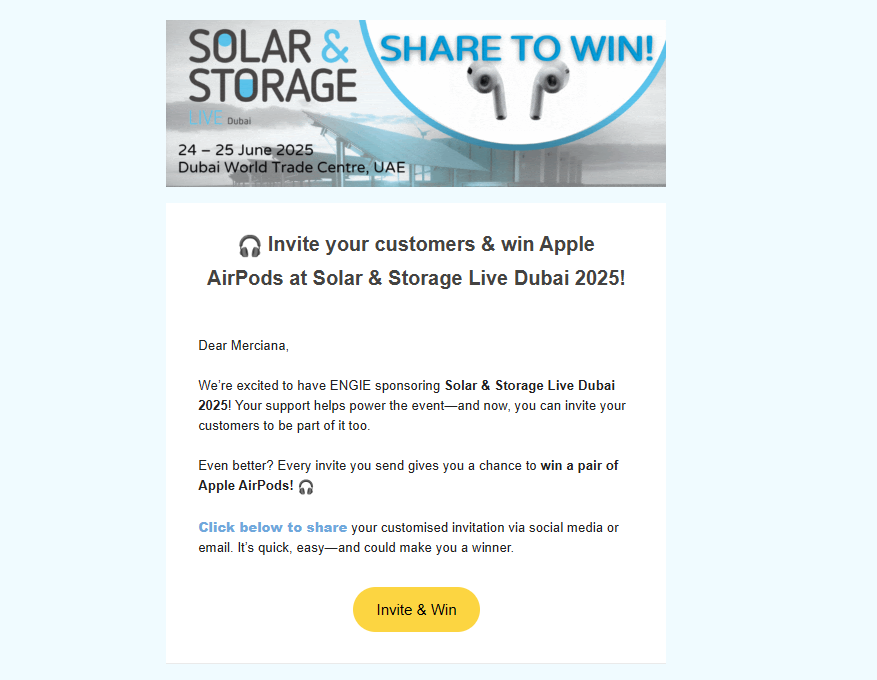
The logic across all three is straightforward: each person received approval to participate in something meaningful to them professionally. Each one has a network that overlaps with your target audience. And each one is most motivated to share at the moment that approval arrives in their inbox.
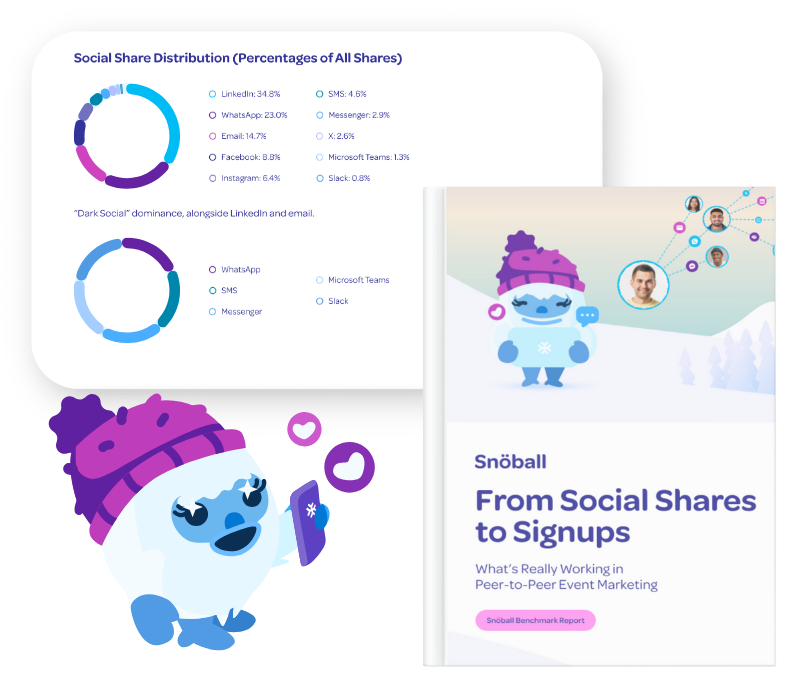
Snöball’s 2026 Peer-to-Peer Event Marketing Benchmark Report puts numbers to this. LinkedIn, WhatsApp, and email account for the top three sharing channels globally, at 34.8%, 23%, and 14.7% respectively. These are where professionals talk to other professionals. Speakers share on LinkedIn because it reinforces their authority. Exhibitors share via WhatsApp and email because that is where their client relationships live.
When you treat every confirmation email as a potential first share, you are activating a network, not just confirming attendance.
What to Actually Add to Your Confirmation Email
Turning a confirmation email into a marketing asset does not mean making it longer. It means making it work harder. The elements below are practical, low-friction additions that give your registrant somewhere to take their excitement.
1. A peer-sharing widget
This is the most direct way to turn a confirmation email into amplification. A sharing widget lets registrants post to their network in one click, across the channels where their peers actually are. LinkedIn for professional audiences. WhatsApp for high-trust group conversations. Email for personal invitations that feel like they came from a colleague, rather than a brand.
According to Snöball’s 2026 Benchmark Report, 32.6% of all peer-to-peer event shares happen through private channels like WhatsApp, Slack, and direct messages. That is the single largest share environment in the data, larger than public social. If your confirmation email only points to LinkedIn, you are missing more than half the conversation.
Read more: Why Snöball Supports 17 Social Channels for Peer-to-Peer Event Marketing
2. Pre-written social copy
Write it for them. A short, ready-to-post caption for LinkedIn, a message they can forward on WhatsApp, a one-liner they can drop in Slack. Keep it in their voice, not your brand voice. “Just registered for [Event Name], if you’re in [industry], you should be there too” will outperform a corporate announcement in almost every case, because it reads like a peer recommendation rather than a press release.
3. A value-reinforcing line
The confirmation email typically tells registrants what they signed up for. It rarely reminds them why it matters. One or two lines that reconnect them to the value of the event, a standout speaker, a key topic, a community they are now part of, reinforces their decision and gives them something worth sharing. Registrants who feel good about their decision share. Registrants who are already second-guessing the time commitment tend to go quiet.
4. A referral hook or incentive
A soft incentive at the confirmation stage can meaningfully increase sharing. This does not have to be elaborate. Priority seating, early access to session recordings, a discount for a colleague they refer, or simply recognition as a community advocate. The goal is to give registrants a reason to act while the excitement is still fresh.
5. A calendar invite that works for them
Canva Create’s confirmation email gets this right, as we mentioned before. Five calendar options in a single row: Google, Apple, Outlook, Microsoft, and Yahoo. Every platform your registrant might use is covered. For mobile users especially, this is the difference between adding the event and closing the email.
A note on length and design
None of these additions require a long email. The best confirmation emails are focused and easy to scan. One strong visual. The essential details. A clear next step. The sharing prompt sits naturally after the logistics. Keep the primary CTA singular. A cluttered confirmation email with five competing actions produces fewer clicks than one with a single clear prompt.
Keep the Momentum Going with Booster and Reminder Emails
The confirmation email captures the first wave of enthusiasm. But for most B2B events, the gap between registration and event day stretches weeks or months. Enthusiasm fades. Inboxes fill up. The share your registrant intended to post gets pushed aside.
Booster emails address that directly.
A booster email is a timely nudge sent after the confirmation, designed to re-activate your registrant’s intent to share. It can be brief. A single line reminding them that their colleagues would benefit from attending, paired with a one-click share link, is enough. Timing matters more than length. Send it when there is a natural reason to reach out: a new speaker announcement, a closing early-bird window, a published agenda, or a registration milestone worth mentioning. See the example of HumanX
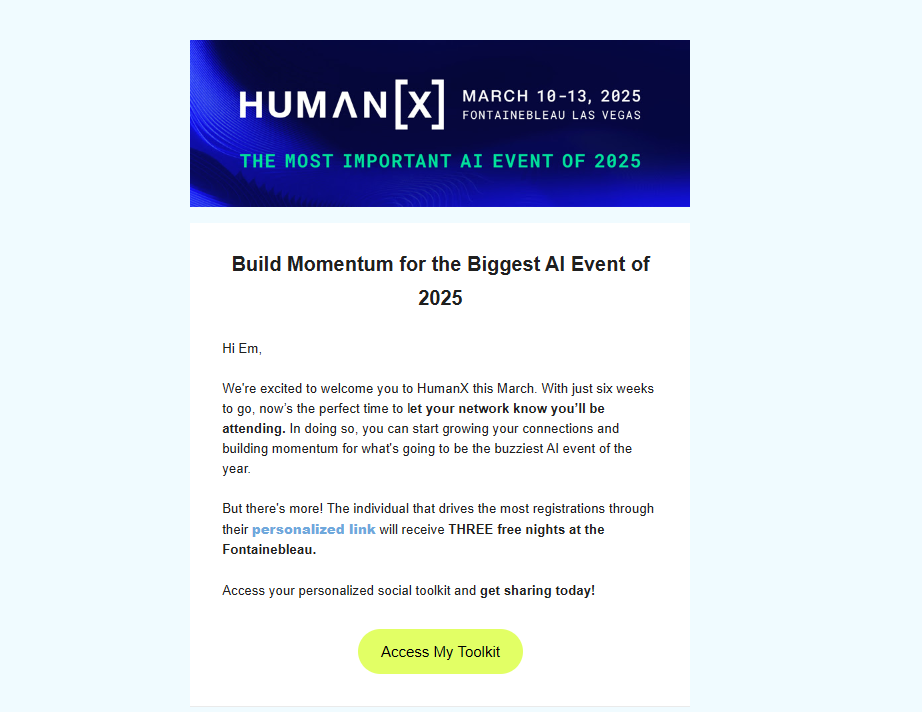
Each of those moments gives your registrant something fresh to share, a new reason to tell their network rather than the same message they received at confirmation.
Reminder emails serve a different but complementary purpose. As the event approaches, registrants need logistical reassurance: hotel blocks, travel details, session schedules, networking opportunities. These emails keep attendance intent high and reduce no-shows. They can also carry a sharing prompt. Someone who registered three months ago and is now actively preparing to attend is riding a new wave of excitement. That is another window worth using.
Here’s a particularly exciting one from Eventastic 2026, where the email urges the recipient to save a free spot and reminds to attend the event for at least 60 mins to get on-demand access.
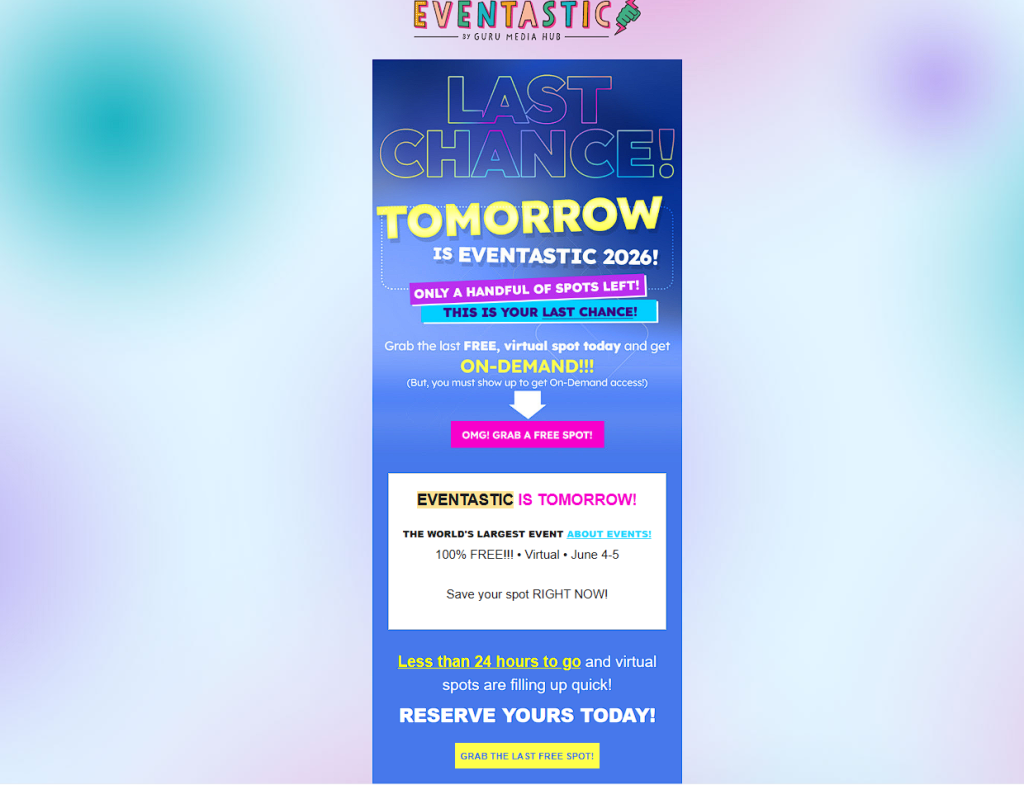
Think of the sequence this way: the confirmation email is the spark. Booster emails keep it going. Reminder emails bring it to a peak just before the event.
This approach works across all your segments too. A speaker who held off after their confirmation email may share once the full agenda is published and they can see their session in context. An exhibitor who missed the first prompt may act when registration numbers are climbing and their customers are visibly attending. Booster emails let you reach each segment at their own moment of motivation.
Read more: Creating a Winning Event Email Marketing Campaign
How to Know If It’s Working
Adding sharing elements to your confirmation email is step one. Connecting those shares to actual registrations is step two. Here is what to track.
Share rate
How many registrants clicked the share widget in your confirmation email? This is your starting point. A low share rate at the confirmation stage usually points to one of two things: the sharing prompt is hard to find, or the pre-written copy is flat. Both are fixable.
Channel breakdown
Where are your registrants sharing? LinkedIn, WhatsApp, email, Slack? This tells you where your audience actually communicates and which channels to prioritize in your booster emails. Snöball’s 2026 Peer-to-Peer Event Marketing Benchmark Report shows LinkedIn leads global sharing at 34.8%, followed by WhatsApp at 23% and email at 14.7%. Your own event’s breakdown may look different depending on your industry and geography. The data will tell you.
Dark social attribution
This is the piece most event marketers overlook. According to Snöball’s report, 32.6% of all peer-to-peer shares happen through private channels: WhatsApp conversations, Slack threads, direct messages, forwarded emails. Standard analytics tools do not capture this. It shows up as direct traffic with no source, or disappears from attribution entirely.
That does not mean it is not working. It means you need tools built to surface it. Dark social attribution connects private shares to actual registrations, giving you a fuller picture of how much peer influence your confirmation email is generating. [
Also read: What is Dark Social in Event Marketing?
Referral conversion rate
Of the people who clicked a shared link, how many actually registered? Snöball’s Benchmark Report found that 31.72% of social shares by stakeholders converted into registrations. When that share came as a direct personal invitation from a peer, the conversion rate reached 37%. Those are conversion numbers paid channels rarely match.
Booster email performance
Track open rates, click rates, and share activity on each booster email separately. This shows you which moments in the pre-event timeline generate the most advocacy. A speaker announcement that drives a spike in shares is telling you something useful about what your audience values.
These metrics, taken together, show you how your confirmation email and the emails that follow it are performing as marketing assets. The goal is simple: connect every share to a registration, and every registration to a person who chose to advocate for your event.
Also read: Why Peer-to-Peer Marketing Delivers Higher Event ROI
TL;DR
- Your confirmation email is the highest-attention touchpoint in your pre-event communication. Most events use it only for logistics.
- The moment someone registers is the peak of their pre-event enthusiasm. That is the best time to ask them to share.
- Every segment, attendees, speakers, exhibitors, and sponsors, has a reason to tell their network. The confirmation email is where that activation starts.
- Adding a sharing widget, pre-written social copy, a value-reinforcing line, and a soft referral incentive requires intent, not a redesign.
- Booster and reminder emails extend the momentum. Each one is another opportunity to re-activate sharing across your entire registrant base.
- Track share rate, channel breakdown, dark social attribution, and referral conversion rate to understand what is actually driving registrations.
Conclusion
Every event marketer knows the feeling of a registration coming in. A small win. Proof that the marketing is working.
What is easy to miss is that the person who just registered is, at that exact moment, your most motivated advocate. They are excited. They are connected to a network of peers who work in the same industry, attend the same kinds of events, and would likely benefit from being in the same room. And they are holding a device that lets them tell all of those people in seconds.
The confirmation email is your one guaranteed touchpoint with that person at that moment. What it says, and what it invites them to do, determines whether that excitement stays private or becomes your next wave of registrations.
A receipt ends the transaction. A marketing asset starts a conversation.