

There is a quiet shift happening in event marketing. The best organizers are no longer guessing where to spend. They are learning how their audience actually communicates.
We call this Peer Intelligence. It is the ability to understand how your audience shares, influences, and makes decisions—and to use that data to guide where and how you market.
Because for years, event marketing has operated in reverse. We choose channels. We allocate budget. We optimize after the fact.
But what if your audience already told you exactly where to focus.
Why traditional targeting falls short
Most marketing strategies still rely on a familiar set of signals: Clicks. Visits. Form fills.
And while those signals are useful, they are incomplete. They tell you what happened. They do not tell you how people actually communicate.
Events are not e-commerce. They are driven by trust, identity, and professional alignment. People do not attend because they were chased by an ad. They attend because someone in their network made it relevant.
According to Forrester’s B2B Trust research published in March 2025, 82% of B2B buyers say coworkers and colleagues are their most trusted information source, ranking above analysts, vendors, and any media channel.
When you rely only on click-based data, you are optimizing for attention, not influence. That is the gap Peer Intelligence fills.
Peer Intelligence is not social listening
Social listening has been around for years. It helps marketers understand what people are saying across public channels.
But event growth does not happen in public alone. It happens in:
- private messages
- group chats
- direct emails
- one-to-one recommendations
Places traditional social listening cannot see.
Peer Intelligence captures something different. Not just conversation, but influence. Not just sentiment, but action.
It shows:
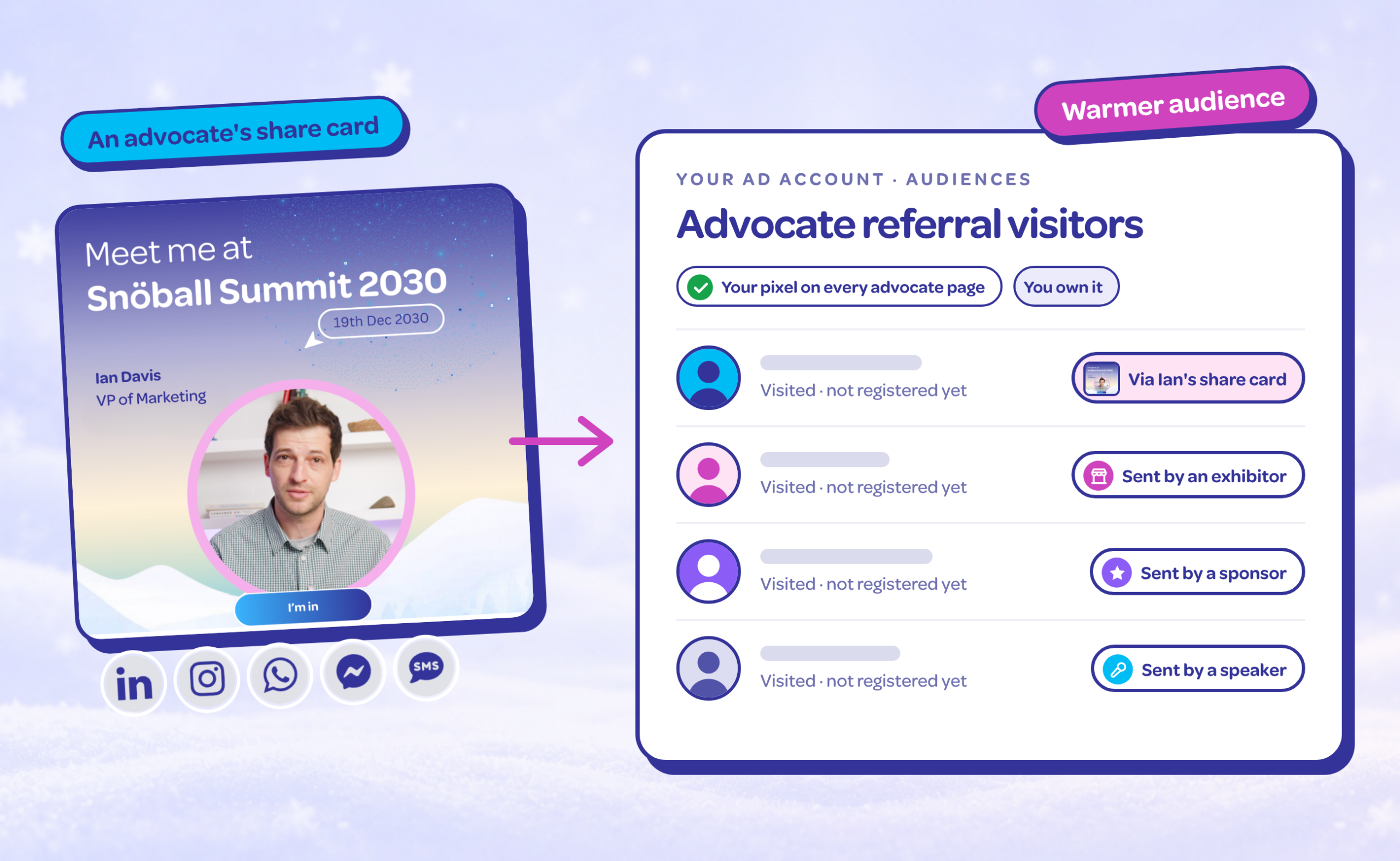
- who shared
- where they shared
- and what actually led to a registration
In practice, this looks like launching a campaign with sharing tools available across 17 platforms, watching the engagement data come in, and narrowing focus to the five channels actually driving results. Not deciding in advance. Following the signals.
Because in event marketing, what matters is not what people say. It is what they do—and who influenced them to do it.
The signals your audience is already sending
This idea came into focus while working with Premiere Show Group on their 2024 campaign for Premiere Orlando. Erin McDonald, their Marketing Director, said:
“We gained valuable insights from the dashboard about how our attendees communicate. It allowed us to adapt not only our campaigns, but our overall marketing approach.”
When Premiere Orlando activated over 20,000 advocates, they did not just generate reach. They uncovered behavior.
For example:
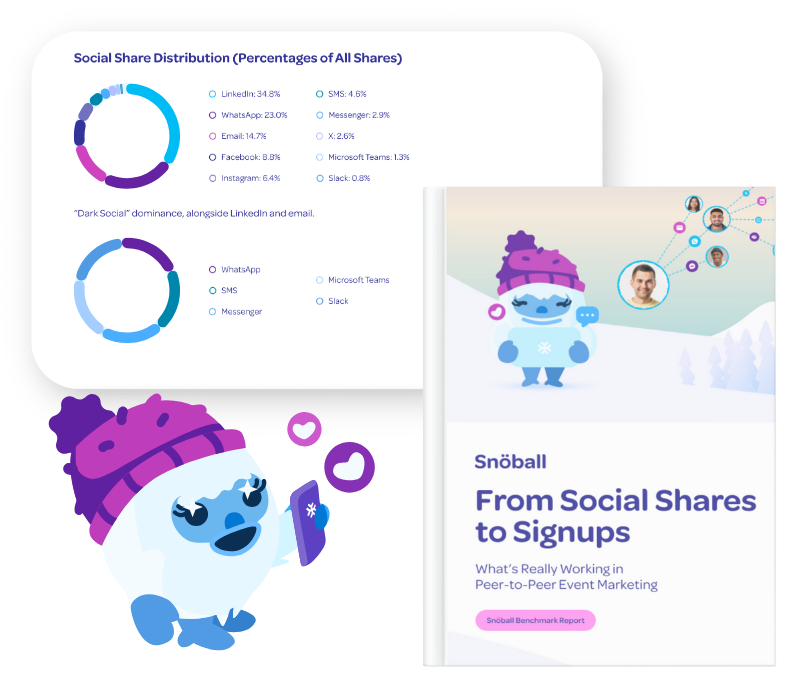
- WhatsApp showed meaningful adoption among beauty professionals (~10%), a channel most organizers would not have predicted or prioritized
- SMS carried significant share activity (~16–19%), confirming that private, direct channels were driving behavior that no public dashboard would have captured
- Facebook Messenger (22.8%) reinforced the same pattern
- Instagram led overall share activity at 27.5%
- Email remained part of the mix (~8.6%), but was no longer the primary channel
The results followed from acting on those signals:
- 18% increase in attendance
- More than 4,000 social shares, doubling the previous year
- A 6x return on investment
- A 121% increase in landing page views
But the real impact was not just growth. It was clarity. They understood how different parts of their audience communicate. That insight shaped where they invested, how they messaged, when they activated campaigns, and how they prioritized their audience.
That is Peer Intelligence in action.
Channel behavior shifts by audience
The same principle played out very differently at HumanX 2025, the inaugural AI industry conference held in March 2025 at the Fontainebleau Las Vegas. The event attracted more than 3,500 attendees and 300 speakers from organizations including OpenAI, Anthropic, Hugging Face, and Databricks.
Where Premiere Orlando’s beauty professional audience gravitated toward Instagram, WhatsApp and SMS, the HumanX audience was concentrated almost entirely on LinkedIn, which accounted for 67.1% of all social shares.
Snöball mobilized 5,057 advocates across attendees, speakers, partners, and sponsors. As engagement data came in, the team narrowed focus to the five channels actually driving results.
The final numbers: a 196X return on investment, 17,813 landing page views, and a 67.8% email open rate—well above the 20–25% industry average for event marketing campaigns.
Stefan Weitz, Co-founder and CEO of HumanX, summed it up: “It was such an easy onboarding experience, totally helped the attendees share their attending experience and helped us drive a ton more delegates.”
The contrast between these two campaigns makes the point. A channel strategy built for beauty professionals would have been largely wasted on an AI and tech audience. The platforms were different, the formats were different, and the timing that produced sharing momentum was different. What stayed consistent was the method: understand how the specific audience communicates, then build around that rather than around assumptions.
What Peer Intelligence looks like in practice
Peer Intelligence is not another channel. It is a layer that sits above your entire marketing strategy.
Here is how leading organizers are starting to apply it:
1. Identify your natural promoters Speakers, exhibitors, partners, and highly engaged attendees. These are not just participants. They are distribution channels.
2. Map how they communicate Look beyond clicks and impressions. Understand which channels they use, how they share, what formats resonate, and what triggers action. At HumanX, this meant recognizing early that LinkedIn was driving the overwhelming majority of sharing and concentrating effort there. At Premiere Orlando, it meant seeing WhatsApp and SMS activity that would have been invisible to any traditional tracking tool.
3. Align your spend with real behavior Instead of forcing attention through predefined channels, you follow the signals. Double down on platforms already driving peer sharing. Match your paid strategy to how advocates naturally promote. Prioritize audiences connected to high-performing promoters. This is exactly what the HumanX team did when they moved from 17 platforms to five.
4. Mirror the tone, format, and messaging that is already converting Your strategy becomes a reflection of reality, not a guess.
The shift ahead
Event marketing is not becoming more complex. It is becoming more transparent.
Your audience is already telling you:
- where they spend time
- how they share
- who they trust
- and what drives them to act
Peer Intelligence is simply learning how to listen. And the organizers who do will stop guessing where to spend and start building strategies that align with how their events actually grow.