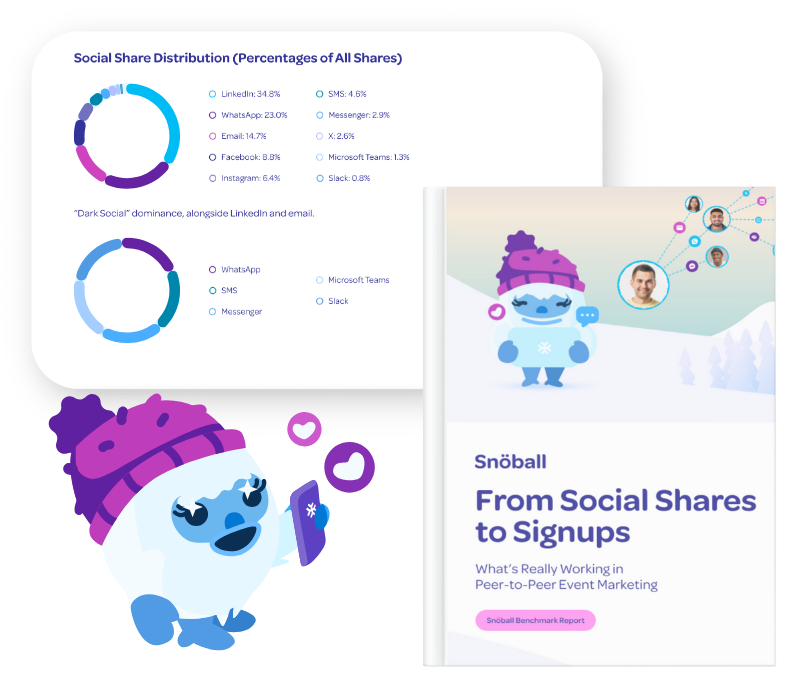

According to Snöball’s 2026 P2P Event Marketing Benchmark Report, 31.9% of event registrations happen through peer-to-peer (P2P) shares. Of these total shares, 32.6% come from private channels like WhatsApp conversations, Slack communities, SMS, and direct messages, which standard analytics might never track.
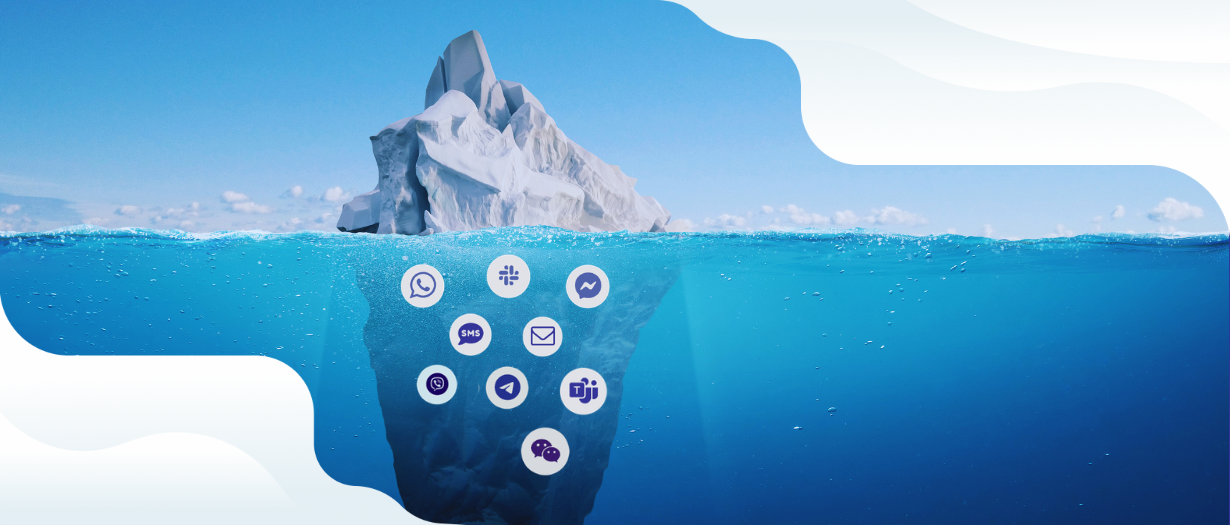
Think of your event marketing like an iceberg. What you see above the surface: the email clicks, the LinkedIn impressions, the ad traffic, is only part of the picture. Underneath is a whole layer of conversations that are driving people to register, like:
- WhatsApp chats between colleagues.
- Slack threads inside industry communities.
- Forwarded emails with a short “this looks relevant.”
- Quick messages like, “are you going to this?”
In marketing, this is called Dark Social: traffic and influence that cannot be traced back to a specific source. For event marketers, it represents a real blind spot. The channels that show up in your analytics are often not the only ones that actually moved someone to register.
This article explains why events are especially vulnerable to this, who is already driving registrations, and how to start measuring the source.
Here is what we will cover:
- The invisible growth engine behind event registrations
- What dark social means in event marketing
- Why events are especially vulnerable to dark social
- Why private channels tend to outperform traditional marketing campaigns
- Your advocates are already doing this, just not for you
- The activation gap
- The attribution problem no one wants to admit
- What Snöball’s 2026 Peer-to-Peer Event Marketing Benchmark report reveals
- Making dark social measurable without killing trust
- Four tactics to implement dark social in 2026
The invisible growth engine behind event registrations
Attending an event is not a small decision. Someone is weighing travel costs, time out of office, and whether the event is worth the disruption. That kind of commitment does not follow a single marketing email. It follows a colleague saying: “I’m going. You should come too.”
The event industry runs on face-to-face connection, yet event marketing largely ignores the channel where attendance decisions often actually happen: private conversations.
A speaker tells their Slack community they will be presenting. A past attendee tells three contacts it was worth the trip last year. A colleague forwards a registration link with a one-line message. None of this shows up in a dashboard. All of it drives registration.
The data backs this up. In 2024, 58% of event attendees cited peer connection as their primary motivation for attending in person, up from 39% in 2021 (Freeman Networking Trends Report, July 2025). And 51% say that connecting meaningfully with just one other person is reason enough to return. Peer connection is not a feature of a good event. For most attendees, it is the point.
This is not just an events thing. 65% of CMOs begin vendor searches inside peer communities, before Google, before review sites, before any vendor content (Wynter, January 2026). The people event marketers are trying to reach default to peer input while evaluating their options. Event attendance decisions follow the same pattern.
What dark social means in event marketing
Dark social refers to traffic and influence that comes from private, untrackable channels. The term was coined by Alexis Madrigal in a 2012 article in The Atlantic. When someone shares a link through WhatsApp, Slack, email, or direct messages, analytics tools typically cannot identify the source, and the visit is recorded as “Direct.” The interaction that led to that click remains invisible.
That is the technical reality. But for event marketers, the more useful framing is this – dark social is where professional trust lives.
WhatsApp, Slack, Teams, LinkedIn DMs, and SMS are not just channels without tracking. They are the environments where recommendations are made, decisions are validated, and professional credibility gets passed from one person to another. The reason they are difficult to measure is the same reason they are so persuasive. They are personal.
SparkToro research confirms this: 100% of visits referred from WhatsApp, Slack, and Discord are recorded as direct traffic in analytics. The most persuasive channel in B2B communication is also the one that leaves no trace.
63% of internet users are more likely to share content via private messaging apps than via open social platforms (GWI, January 2025). This is not a niche behavior confined to certain regions or event types. It is how people communicate by default.
Why events are especially vulnerable to dark social
Most industries deal with some version of dark social. Events are affected more, because of how attendance decisions are actually made.
Attending an event involves real money, real time, and a visible professional commitment. People need peer confirmation before they sign off on an investment. That confirmation almost always happens in a private conversation, not on a public channel.
The audience also communicates through professional tools by default. B2B event audiences live in Slack, Teams, LinkedIn DMs, and WhatsApp groups. These are not just dark to analytics. They are where actual professional relationships play out, which is exactly what makes them so influential.
Then there is the decision timeline. Events are not impulse purchases. The gap between “I heard about this” and “I registered” can span weeks and involve multiple private exchanges. None of that journey gets captured.
The network already exists, and that is actually useful.
Speakers have communities built around their expertise. Exhibitors have prospect lists of people they want to meet on the show floor. Past attendees have professional circles that include exactly the kind of people who should be at your event. Every one of these people is already connected to someone inside your event. The network is already the channel. The question is whether it is being treated as one.
Why private channels tend to outperform traditional marketing campaigns
When a message arrives from someone you know and trust, it already carries their credibility. You do not have to evaluate the source.
The recipient also knows exactly why it was sent to them. The personalization is built into the relationship, not engineered by a segmentation tool. And the timing is human. The recommendation arrives when it is relevant, not when a campaign scheduler decides to send it.
A WhatsApp inbox is not a marketing environment. Messages there get read because they are from real people, and that attention is near-total in a way no paid channel can replicate.
The performance gap is significant. WhatsApp messages achieve a 98% open rate, against roughly 20% for email. Referral links shared via WhatsApp convert at 18 to 25%, nearly three times higher than email’s 6 to 7%. And 67% of users report higher trust in a business when they can reach it directly via WhatsApp (Electroiq, November 2025).
In Snöball-run event campaigns, 32.6% of all advocate referral shares happen via dark social channels. It is the single largest share environment in the data, larger than email, larger than public social (Snöball 2026 P2P Event Marketing Benchmark Report).
No paid channel delivers those conversion numbers, and until recently, none of it was showing up in attribution models.
Your advocates are already doing this — just not for you
Speakers, exhibitors, sponsors, past attendees, and partners are already sharing your event in private channels. The organizer gets none of the visibility and none of the attribution.
The peer influence behind this behaviour is significant. Word of mouth is the top consideration factor for 42% of B2B CMOs when evaluating software, with cold outreach ranking last at just 2% (Wynter, January 2026).
The pattern holds in event decisions too: the people your event is trying to reach trust peer recommendations above every other input. And 80% of those CMOs arrive at a vendor conversation already familiar with the company, meaning the real influence happened in conversations the vendor never saw.
The same thing happens in event marketing every day. Your advocates are already having those conversations. The problem is not getting them to share. It is that none of it is being structured, tracked, or scaled.
The activation gap
Most event teams sense the attribution problem. Fewer recognize what is causing it upstream: advocates are not being equipped to share in any structured and trackable way.
Event marketers can close that gap by prompting their audience to share at the right moments. For instance:
- Right after registering, on the confirmation page
- Inside the confirmation email
- Within a speaker’s profile or speaker management portal
- Inside exhibitor or sponsor dashboards
These are natural points of intent. The motivation to share already exists. What is often missing is the mechanism.
Most event teams never give their advocates trackable referral links or pre-written messages that are easy to forward. There is usually no way for advocates to see whether their shares are actually converting. Without the right tools, a share happens however they choose, goes wherever it goes, and gets attributed to nobody.
This is also where integrations start to matter. When sharing tools are embedded directly into platforms like Cvent, Sessionboard, A2Z, or Map Your Show, advocates do not need to leave the environment they are already in. Sharing becomes part of the experience rather than an extra step.
Without that layer, sharing stays informal. Informal sharing stays invisible. And invisible influence gets cut from the budget, even when it is the channel doing the most work.
The attribution problem no one wants to admit
Event marketers are under growing pressure to prove ROI, yet the channel most responsible for driving registration decisions is the one their analytics cannot see.
73% of marketers report significant attribution challenges following Apple’s iOS 14.5 privacy changes (Direct Agents, August 2025). And 63% of businesses struggle to accurately track campaign performance, with last-click models misallocating up to 40% of conversion credit to the channels that closed the deal rather than the ones that built it (Numento Technology, November 2025).
In event marketing, the gap is pretty specific.
A significant share of promotion happens in private channels. As mentioned earlier, Snöball’s 2026 Peer-to-Peer Event Marketing Benchmark Report shows 32.6% of advocate shares come from WhatsApp, SMS, Messenger, Teams, and Slack. These channels do not pass referral data. Registrations from them show up as “Direct,” with no source attached.
When peer sharing is structured, the impact becomes visible. Snöball campaigns show peer-to-peer driving an average of 6.9% of total audience, and up to 13.2% for top-performing events. Those registrations were always happening. The difference is that now there is a number attached to them.
The teams making progress on attribution are not finding new audiences but capturing the ones their advocates were already reaching.
What Snöball’s 2026 Peer-to-Peer Event Marketing Benchmark report reveals
The global numbers show that peer-to-peer drives registrations. The regional data shows something more specific.
Dark social is not a side channel. In many cases, it is where a large share of sharing actually happens.
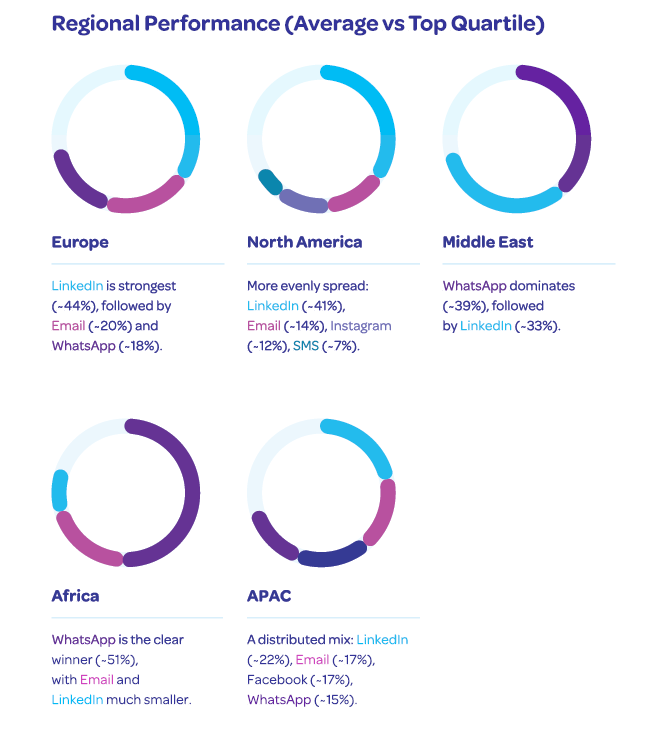
Across regions, the same set of channels is available. What changes is how much of that activity happens in private, direct environments versus public ones.
Here’s how that plays out:
- Europe
LinkedIn leads (~44%), but private channels like WhatsApp (~18%) still account for a meaningful share alongside email (~20%). Dark social is present, even if not dominant. - North America
More evenly distributed. LinkedIn (~41%) leads, with email (~14%), Instagram (~12%), and SMS (~7%). Private sharing exists, but is spread across multiple channels rather than concentrated in one. - Middle East
WhatsApp (~39%) is the leading channel, with LinkedIn (~33%) close behind. A significant portion of sharing happens through private messaging. - Africa
WhatsApp dominates (~51%), with email and LinkedIn much smaller. Most peer-to-peer activity here happens through direct, private communication. - APAC
A distributed mix. LinkedIn (~22%), email (~17%), Facebook (~17%), and WhatsApp (~15%) all contribute. Dark social is part of the mix, even if not concentrated in a single channel.
Two things become clear.
First, dark social is not uniform. In some regions, it is the primary way events are shared. In others, it supports public channels but still plays a meaningful role.
Second, private channels scale with behavior, not campaign design. The same campaign produces different results depending on how people in that region communicate day to day.
For event marketers, this changes how channel strategy should be approached.
Making dark social measurable without killing trust
The goal is not to monitor private conversations. It is to give advocates shareable links built for private channels and capture who shared, without touching what was said.
Advocates share because they trust the event and want to help their network. If the tracking feels intrusive or transactional, that dynamic breaks down. The share stops feeling personal, which is exactly what made it effective in the first place.
What works is simpler.
Give advocates personalized, trackable links they can use in the channels they prefer. The conversation stays private, but the results are measurable.
This shift matters because attribution is already a known gap.
38% of marketers identify attribution as their number one analytics challenge, ahead of personalization, data quality, and channel fragmentation (Marketing LTB, November 2025).
Across Snöball campaigns, trackable peer shares convert at 31.9%, turning previously unaccounted activity into something measurable.
And when that sharing is supported at scale, it extends reach beyond what paid channels achieve on their own, increasing overall event visibility.
Four tactics to implement Dark Social in 2026
1. Design messaging for private sharing. The content that spreads through Dark Social channels is usually specific, relevant, and personally sent. Create assets and messages that work in that context, not just content built for a feed.
2. Equip advocates properly. Give speakers, exhibitors, sponsors, and current and past attendees personalized referral links and ready-to-forward messages. The difference between informal sharing and measurable advocacy is the infrastructure you provide.
3. Read your direct traffic differently. “Direct / None” is not a mystery category. In most cases, it is your advocates working without attribution. Before cutting what looks like an underperforming channel, look at what share volume might be sitting underneath that label.
4. Manage dark social as a performance channel. Peer referral links convert at nearly three times the rate of email. No ad budget buys the credibility that comes with a personal recommendation. The data supports treating peer advocacy as a primary channel, not a footnote.
76% of B2B CMOs still prefer getting vendor advice from real people, even as AI usage for vendor research tripled year-over-year. AI is changing how buyers build shortlists. But trust still travels through people, and it travels through the channels analytics cannot see.
Bottomline
Dark social is easy to overlook because it does not behave like a traditional channel. It does not show up cleanly in reports, and it does not follow campaign logic. But it plays a central role in how people decide whether an event is worth their time.
For event marketers, the implication is straightforward.
If something is influencing registrations, it needs to be understood and measured. Otherwise, decisions about budget, channels, and performance are being made on an incomplete picture.
The opportunity is not in trying to control these conversations, but in building a way to see their impact and work with them.
Teams that do this are not guessing where growth is coming from. They are able to align their strategy and spend with what is actually driving attendance.
If you want to understand how this plays out for your event, your audience, and your industry, it is worth exploring further.
Talk to Snöball to see how dark social can be measured and applied in practice.