

The “convince your boss” letter has been a staple of B2B events for years.
It usually starts with “Hi [Manager Name], I’d like to attend [Event Name],” followed by a few bullet points about learning outcomes and a promise to share takeaways on return.
The problem lives in the format itself. C-suites are under real budget pressure, and travel plus time away from core responsibilities both carry hard costs. A generic letter with vague learning outcomes leaves the manager’s real question unanswered: what does the organization get back?
To tackle this and boost registrations, many events have started solving this problem themselves. Instead of leaving attendees to write their own justification from scratch, they have built tools and entire pages that do the work.
Interactive ROI calculators, AI-generated approval letters, real outcome stories from named companies, manager-facing guides, team participation frameworks, and objection-handling resources that address the likely pushbacks before they are raised.
Most of these are consolidated into a single page to make for a more compelling case to attend.
This article looks at 15 events that took ownership of the approval problem and built tools to solve it themselves.
Table of Contents
1. ITC Vegas – The Cost-of-Absence Calculator
2. HumanX Amsterdam 2026 – The Personalized Recommendations Pack
3. ServiceNow Knowledge 2026 – The AI Letter Generator
4. Dreamforce – An AI Agent That Sells the Value of Attending
5. Money20/20 USA – The Business Case Built on Real Outcomes
6. UNBOUND 2026 – The Full Friction Removal Engine
7. ELX Annual Congress 2026 – Replacing the Static Letter with a Custom GPT
8. ISC West 2027 – The Boss-Ready Business Case
9. SXSW – The Approval Toolkit Built Into the Event Experience
10. HIMSS – The Organizational Value Justification Model
11. AFP Annual Conference 2026 – The Structured ROI Proposal
12. SHRM 2026 Annual Conference – The Manager-Ready Business Case
13. ODSC AI East – The AI Upskilling Approval Framework
14. HLTH 2026 – The “Bring Your Team” Strategy
15. Ai4 – The Data-Backed ROI Case
1. ITC Vegas – The Cost-of-Absence Calculator
InsureTech Connect Vegas (September 29 to October 1, 2026, Mandalay Bay) is the global meeting point for the insurance and insurtech ecosystem, bringing together carriers, investors, and technology leaders.
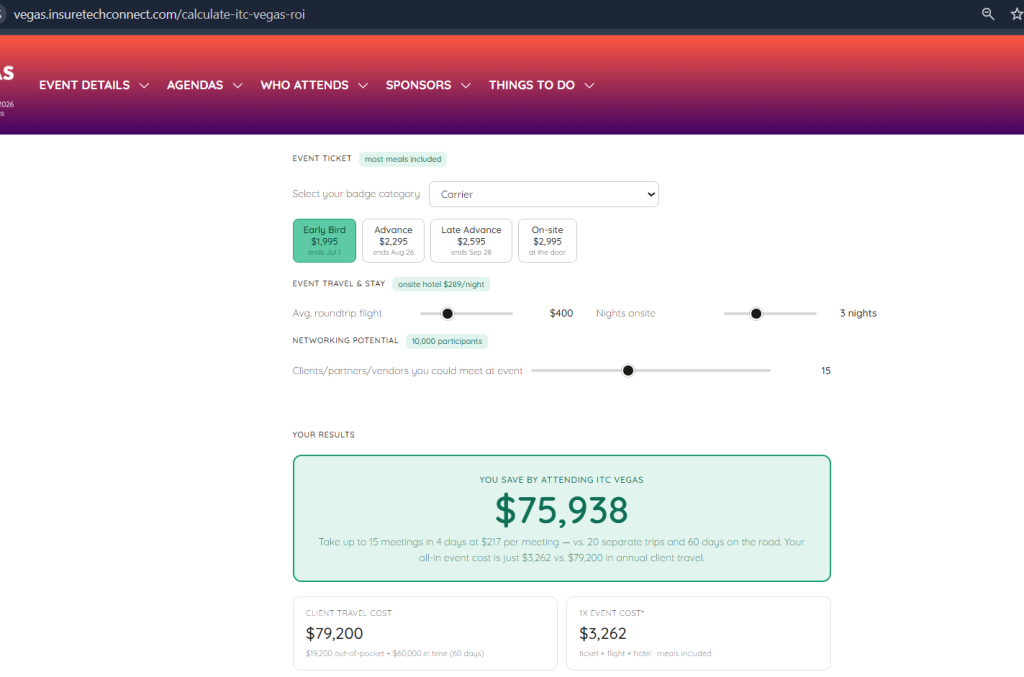
What they did differently: Instead of justifying the trip, ITC Vegas shows what it costs to skip it. Their interactive ROI calculator asks users to enter their annual travel behavior ( client visits, flight costs, hotel rates, time value) and computes those costs against the all-in price of attending.
One sample output: $79,200 in annual travel vs. a $3,262 event cost, a saving of $75,938.
How it stands out
This is a smart reframe in event marketing. The anchor is around inaction and it shows what you will miss or save in real dollar terms if you don’t attend the event. The results can be saved as a PNG or PDF for further sharing.
2. HumanX Amsterdam 2026 — The Personalized Recommendations Pack
HumanX Amsterdam 2026 takes place September 22–24 at RAI Amsterdam, bringing together 2,500+ attendees, 200+ speakers, and 150+ sponsors from across the AI ecosystem. But one of the more interesting things about the event happens before an attendee even walks through the doors.
What they did differently: HumanX built an AI-powered Personalized HumanX Pack directly into its event experience. Instead of giving every prospective attendee the same generic list of reasons to attend, the experience asks users to generate a pack tailored to their role and interests.
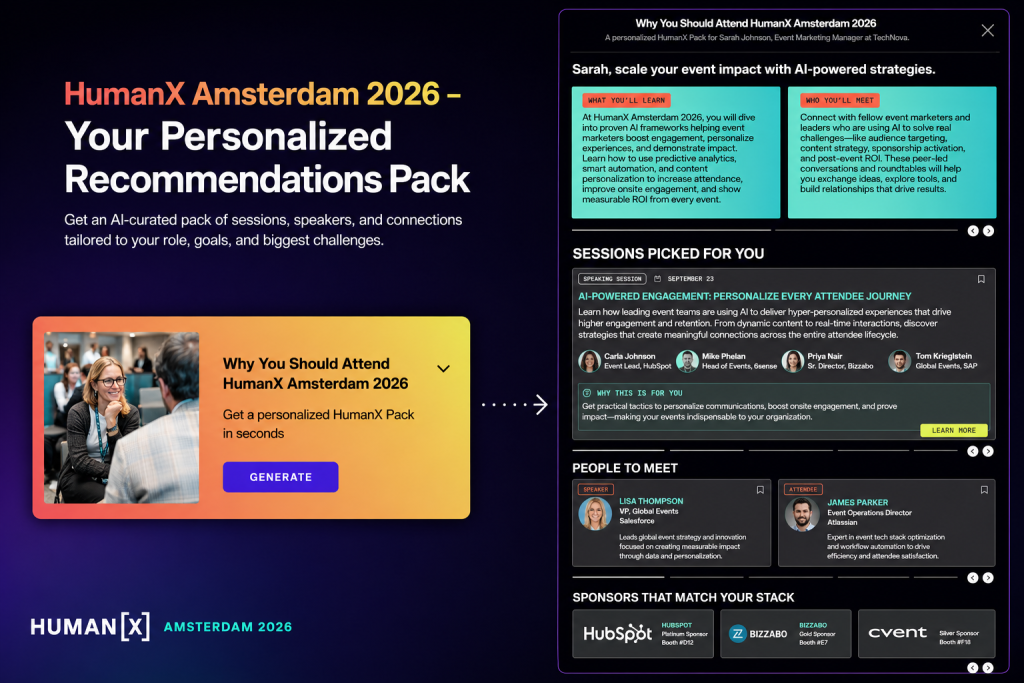
The result brings together personalized recommendations across the event experience — including what the attendee can learn, who they should meet, which sessions are most relevant, and which people and sponsors could be worth connecting with.
For an event marketer, that could mean an Event Marketing Manager gets a very different experience from a Product Leader or AI executive. HumanX already organizes its program around role-based tracks, including Marketing, Customer Experience and Sales within its Customer Engine track, so the personalization connects directly to the way the event content is structured.
The experience effectively turns a huge conference program into a more manageable, personalized plan: here is what matters to you, here is who you should talk to, and here is where you should spend your time.
How it stands out
Most event websites make attendees figure out which sessions, speakers and connections are relevant to them. HumanX does that work upfront.
Its personalized pack turns a huge event into a tailored plan, showing attendees exactly what to learn, who to meet and where to focus. That makes the event feel immediately more relevant, and gives attendees a much stronger case for why it is worth attending.
3. ServiceNow Knowledge 2026 — The AI Letter Generator
Knowledge is ServiceNow’s annual flagship conference covering IT service management, AI adoption, and enterprise workflow. The 2026 edition took place May 5 to 7 in Las Vegas.
What they did differently: ServiceNow embedded an AI-powered tool directly into the registration pricing page. Users answer a few questions about their role and challenges, and the tool generates a personalized, business-focused justification letter ready to copy and send.
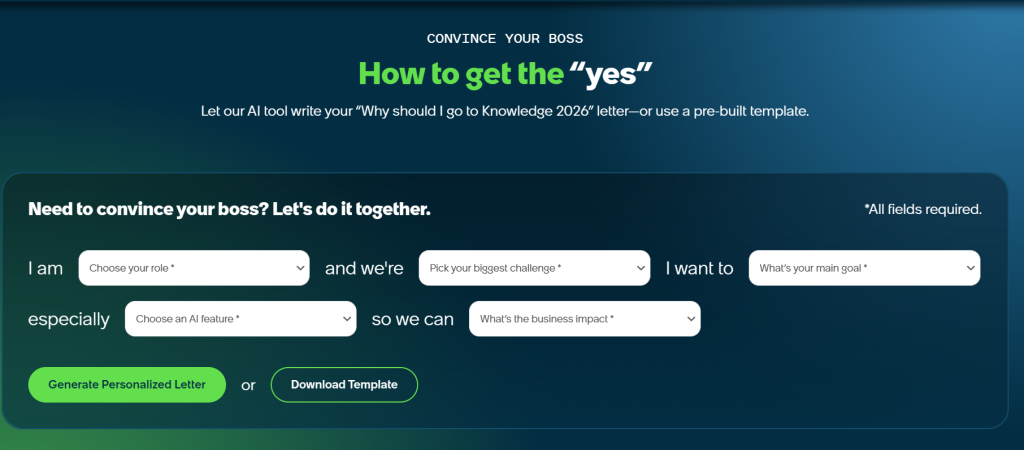
How it stands out
The placement matters as much as the tool itself. It does not sit in a sidebar resource but lives inside the registration experience, surfacing exactly when a potential attendee is already weighing the cost. This is a strong signal of where AI could take attendance marketing next.
4. Dreamforce — An AI Agent That Sells the Value of Attending
Dreamforce is Salesforce’s annual flagship conference and one of the largest technology events in the world, drawing more than 45,000 in-person attendees. Dreamforce 2026 takes place September 15 to 17 in San Francisco.
What they did differently: Dreamforce has a “Convince your boss” button right on the homepage that opens Agentforce, Salesforce’s own AI agent, in a side panel. The agent answers questions about attending, makes the investment case, and surfaces relevant conference information dynamically based on the conversation.
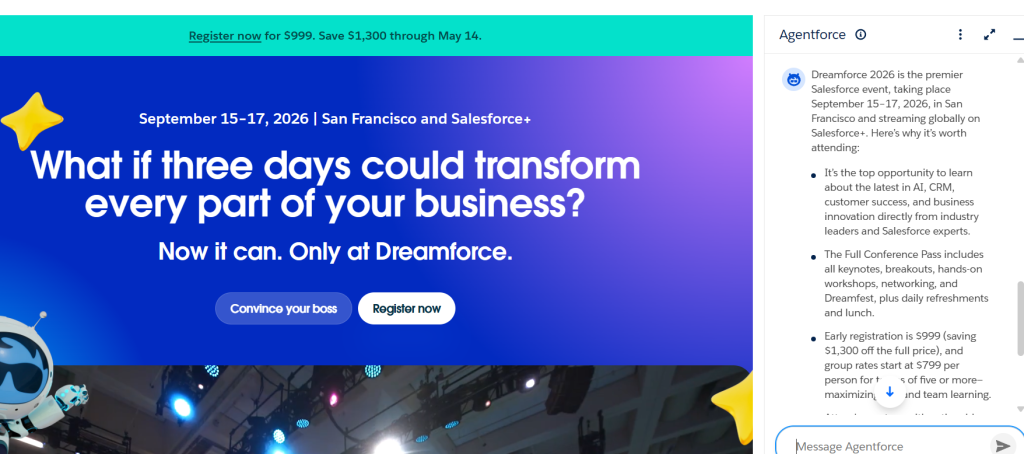
How it stands out
This is Salesforce using their own product to handle the approval conversation. Every potential attendee who clicks “Convince your boss” experiences Agentforce firsthand before registering for a single session, which aligns attendance marketing with their in-house product.
5. Money20/20 USA — The Business Case Built on Real Outcomes
Money20/20 USA is the leading fintech and financial services conference in the Americas, drawing 10,000-plus executives, founders, and investors. The 2026 edition takes place in Las Vegas in October.
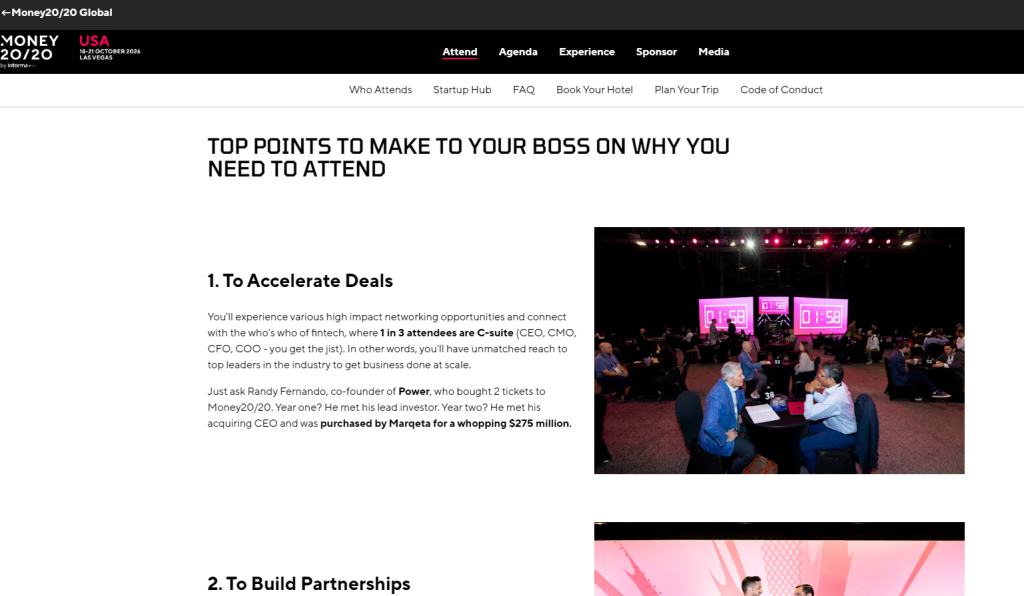
What they did differently: Money20/20’s convince-your-boss page is structured around four business outcomes rather than conference features: accelerating deals, building partnerships, raising your profile, and making breakthroughs.
Each outcome is backed by a real story. Randy Fernando of fintech startup Power attended two years running – year one he met his lead investor, year two he met his acquiring CEO, and Power was purchased by Marqeta for $275 million.
Ntropy formed a new partnership with Beem.
Airwallex reconnected with an investor and secured their Series A.
Mastercard chose the Money20/20 stage to announce their partnership with MoonPay.
The numbers support the stories: 1 in 3 attendees are C-suite, and 7 in 10 are decision-makers.
How it stands out
Most events ask potential attendees to imagine what might happen if they go. Money20/20 shows exactly what happened when real companies did. Naming specific companies, specific outcomes, and specific dollar amounts gives a very strong social proof of the benefits of attending the show.
6. UNBOUND 2026 (Formerly HubSpot INBOUND) — The Full Friction Removal Engine
UNBOUND is HubSpot’s rebranded flagship conference for marketing, sales, and growth professionals. UNBOUND 2026 takes place September 16 to 18 in Boston and marks the event’s evolution from INBOUND to reflect the AI-driven reality of modern growth.
What they did differently:
UNBOUND’s convince-your-manager page tackles the approval problem from multiple angles. It offers:
- A downloadable letter template covering value, costs, and post-event accountability — ready to personalize and send
- Video testimonials from a real manager-IC duo who attended together, divided sessions, and came back with a strategy they activated immediately
- A “What You’ll Bring Back” section giving attendees concrete ROI language to hand directly to their manager
- Pre-written responses to four specific manager objections: budget, team availability, differentiation from other conferences, and how success will be measured
- A 15% group discount for 10 or more attendees, framing the event as a team offsite with built-in programming

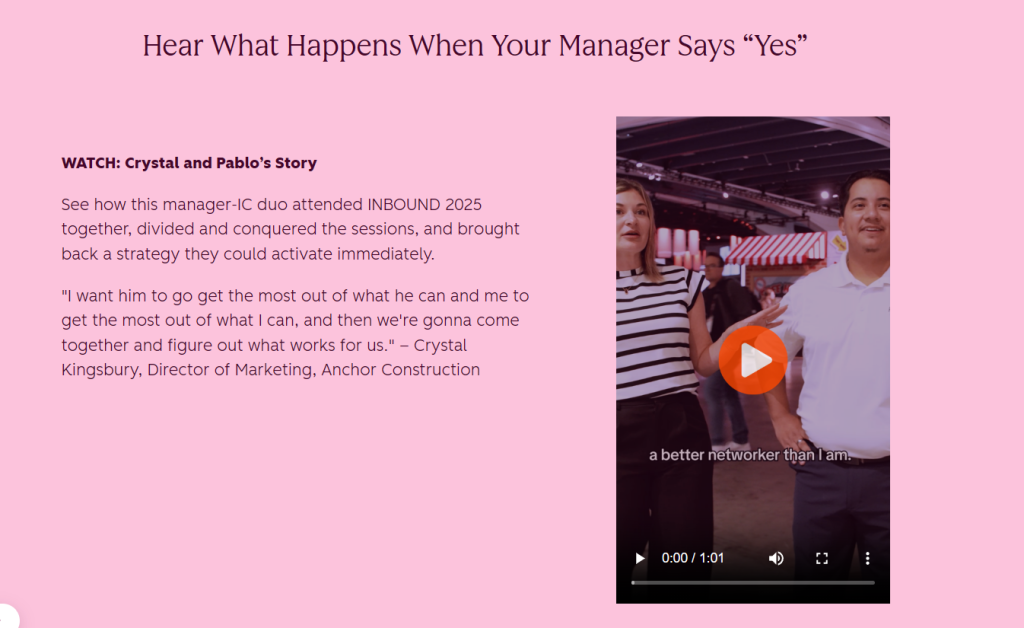
How it stands out
UNBOUND has mapped the entire approval conversation – the letter, the social proof, the ROI framing, the objection handling, the group mechanics – and built a resource for each stage. An attendee could walk into their manager’s office with an answer for every likely pushback.
7. ELX Annual Congress 2026 – Replacing the Static Letter with a Custom GPT
ELX Annual Congress 2026 is the flagship gathering for senior corporate event leaders and in-house event strategists. For its 2026 edition, the organization rethought the standard manager approval letter with a new AI-powered approach.
What they did differently
ELX developed a custom GPT that generates personalized approval emails based on each attendee’s goals, business priorities, and expected outcomes.
The tool guides attendees through structured prompts tied directly to real session content and practical business objectives. Attendees select inputs related to manager expectations, organizational challenges, desired takeaways, post-event deliverables, and even travel costs. Those responses are then translated into a tailored approval email that connects attendance to measurable business value.
The process was initially conceived by ELX CEO Nicola Kastner, who designed the logic and prompting structure inside ChatGPT before the ELX marketing team refined and tested the experience further.
As Nicola explained when introducing the initiative, the goal was to make event approval “more personal, practical, and relevant” for today’s event leaders.
How it stands out
ELX reframed the entire process around organizational outcomes and implementation planning.
More importantly, the event treated approval enablement as an interactive workflow rather than a downloadable asset. The attendee no longer has to figure out how to connect the event to business priorities alone. The system actively builds that case for them using AI, real event content, and structured business context.
It is one of the clearest examples of how AI is turning event justification from a generic template into a personalized decision-support tool.
8. ISC West 2027 — The Boss Ready Business Case
ISC West is the largest physical security tradeshow in North America, run by RX Global. It draws tens of thousands of security professionals, 700-plus exhibitors, and covers everything from access control and video surveillance to AI-driven security and cybersecurity.
What they did differently:
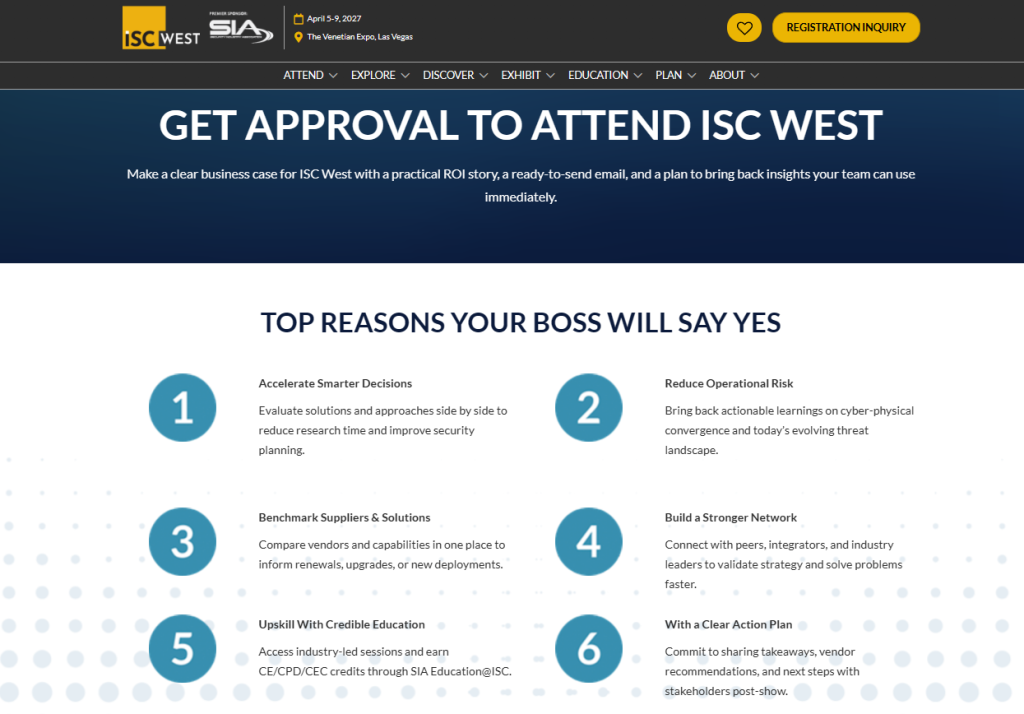
- Frame the entire justify-attendance page around reasons the boss will say yes, not reasons the attendee wants to go
- Six employer-facing arguments: smarter decision-making, reduced operational risk, supplier benchmarking, network building, CE/CPD/CEC credits, and a post-show action plan commitment
- A three-step “How to Make It Happen” guide: tie attendance to current company initiatives, build a focused session agenda mapped to business objectives, and commit to a post-event recap with a vendor shortlist and actionable recommendations
- Includes a ready-to-send email template alongside the strategic framing
How it stands out
Most justify-attendance pages list reasons the event is good. ISC West lists reasons the organization benefits (risk reduction, vendor evaluation, benchmarking) which is a more credible frame for a security industry manager who is already thinking in those terms. The post-show accountability structure (vetted vendor shortlist, actionable recommendations) also gives the attendee something specific to commit to upfront, which makes the ask easier to approve.
9. SXSW — The Approval Toolkit Built Into the Event Experience
SXSW is one of the world’s biggest conferences. It brings together professionals from tech, marketing, film, music, media, gaming, and culture. The 2026 edition ran March 12 to 18 in Austin, Texas.
What they did differently
Most events offer a single email template and call it done. SXSW went further.
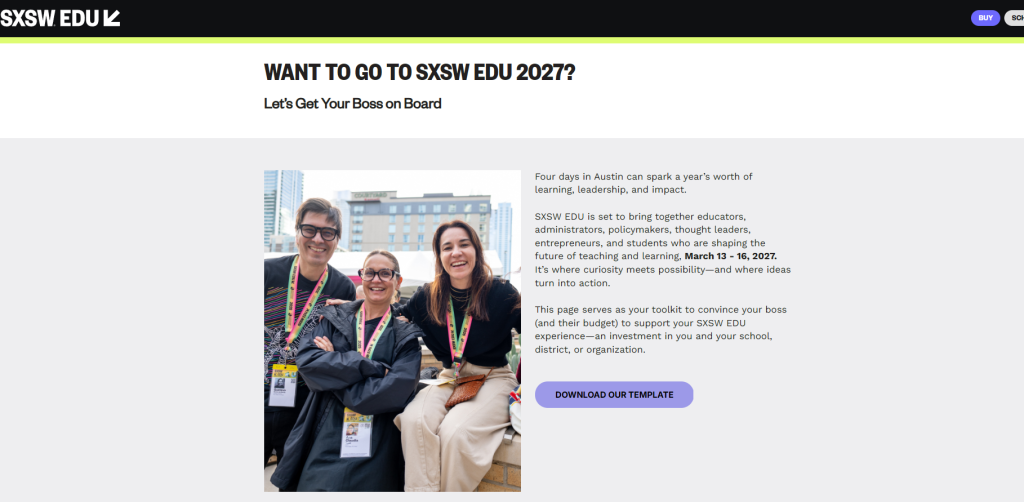
They built approval support into multiple stages of the attendee journey. There is a dedicated “Convince Your Boss” page. Pre-written email templates. Badge guidance tied to professional goals. Group discounts for teams. Planning tools to coordinate attendance internally. And approval messaging baked directly into registration flows.
SXSW EDU goes a step further. It surfaces justification resources inside registration announcements, right at the point when someone is deciding whether to sign up.
How it stands out
Most people are not attending alone. Teams need a plan. They need budget sign-off and internal coordination.
SXSW recognized that and built for it. The ask shifts from “Can I go?” to “How should our team show up?” That is a much easier conversation to have with a manager.
10. HIMSS — The Organizational Value Justification Model
HIMSS Global Health Conference & Exhibition is one of the world’s largest healthcare technology events, bringing together healthcare providers, CIOs, policymakers, clinicians, and digital health leaders. HIMSS 2027 will be held on April 5-8 2027 in Chicago.
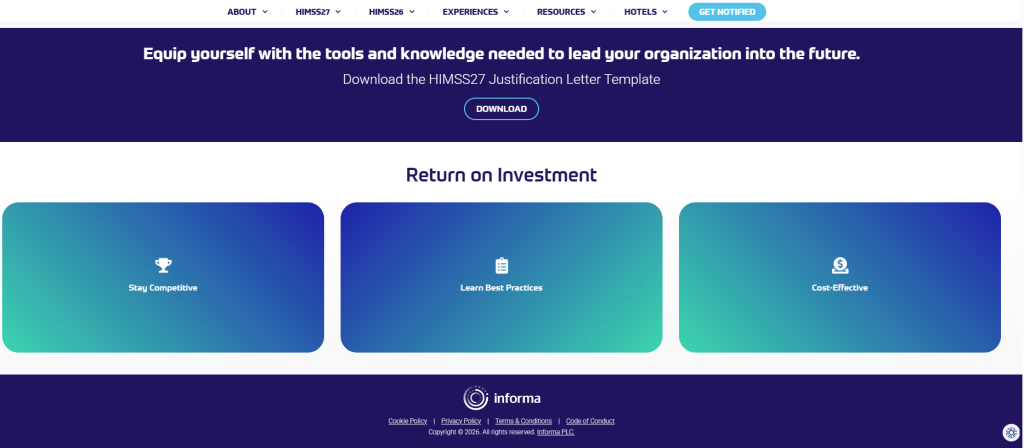
HIMSS has built a dedicated “Convince Your Boss” experience focused heavily on organizational outcomes rather than individual attendee benefits.
The page does not talk about personal growth or career development. It talks about operational efficiency, digital innovation, and healthcare transformation.
It connects attendance to benchmarking, workforce readiness, and measurable business value. Certifications, leadership networking, and session depth are all framed as evidence of return on investment.
How it stands out
In healthcare, the person approving the budget is usually an administrator or department head. They think in terms of outcomes and operational impact, not individual learning.
HIMSS speaks directly to that person. It shifts the entire case toward organizational benefit. And that makes the attendee’s job a lot easier when they walk into that approval conversation.
11. AFP Annual Conference 2026 — The Structured ROI Proposal
The AFP Annual Conference is one of the largest events in the world for treasury, finance, payments, and FP&A professionals. AFP 2026 takes place November 8 to 11 at the Mandalay Bay Convention Center in Las Vegas and is expected to draw nearly 7,000 finance leaders and practitioners.
What they did differently:
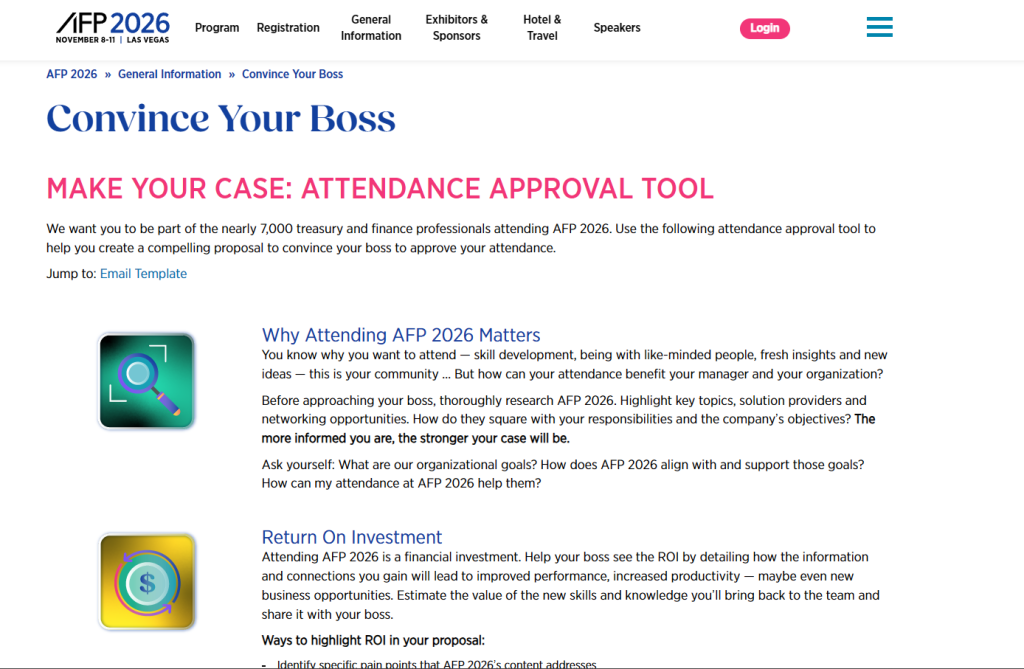
AFP built an attendance approval framework that helps attendees create a stronger internal business case before requesting budget approval.
The conference’s “Make Your Case: Attendance Approval Tool” encourages attendees to connect attendance directly to company priorities, operational challenges, and measurable business outcomes. The guidance focuses heavily on ROI, efficiency gains, benchmarking opportunities, and the practical value attendees can bring back to their organizations.
The page also prompts attendees to map specific sessions, vendors, and educational tracks to organizational goals before presenting the request to leadership.
How it stands out
AFP approaches attendance justification the same way finance teams evaluate investments internally.
The messaging consistently centers on efficiency, measurable outcomes, and business impact. That framing makes the approval conversation feel more strategic and far more credible than the traditional “I’d like to attend this conference” request.
12. SHRM 2026 Annual Conference — The Manager-Ready Business Case
The SHRM Annual Conference & Expo is one of the largest HR conferences in the world, bringing together more than 20,000 HR professionals, business leaders, and workplace strategists. SHRM26 takes place June 16 to 19 in Orlando and focuses heavily on AI, compliance, leadership development, workplace culture, and the future of work.
What they did differently:
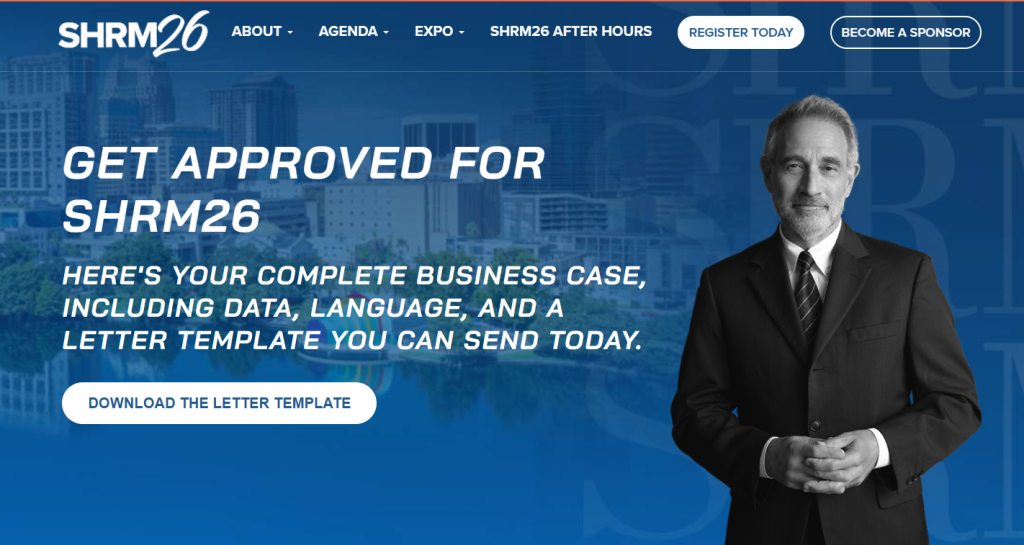
SHRM built a full “Convince Your Boss” resource center designed around business outcomes instead of generic professional development language.
The experience guides attendees through five specific approval angles:
- upskilling,
- curated learning,
- networking,
- cost savings,
- and applied learning.
The event encourages attendees to build a customized curriculum before requesting approval, then connect specific sessions directly to organizational priorities and workplace challenges. SHRM also prompts attendees to commit to post-event knowledge sharing and practical implementation plans.
Another interesting detail: the page coaches attendees on how to frame the request itself. Instead of vague language like “I’d like to attend HR sessions,” SHRM encourages highly specific positioning tied to active company initiatives such as AI adoption, leadership development, retention, compliance, or engagement strategy.
How it stands out
SHRM approaches attendance approval like a workplace improvement proposal. The attendee is encouraged to identify a business challenge, map sessions directly to that challenge, estimate the organizational value of attending, and explain how the learnings will be applied afterward. That structure creates a far more credible approval conversation than the traditional conference request centered mainly on networking or inspiration.
13. ODSC AI East — The AI Upskilling Approval Framework
ODSC AI East is one of the largest applied AI and data science conferences in North America, bringing together AI engineers, data scientists, technical leaders, and business teams for hands-on training, workshops, and discussions around machine learning, LLMs, generative AI, and AI implementation. ODSC AI East 2026 took place April 28 to 30 in Boston.
What they did differently:
ODSC approaches attendance approval through workforce transformation and AI readiness.
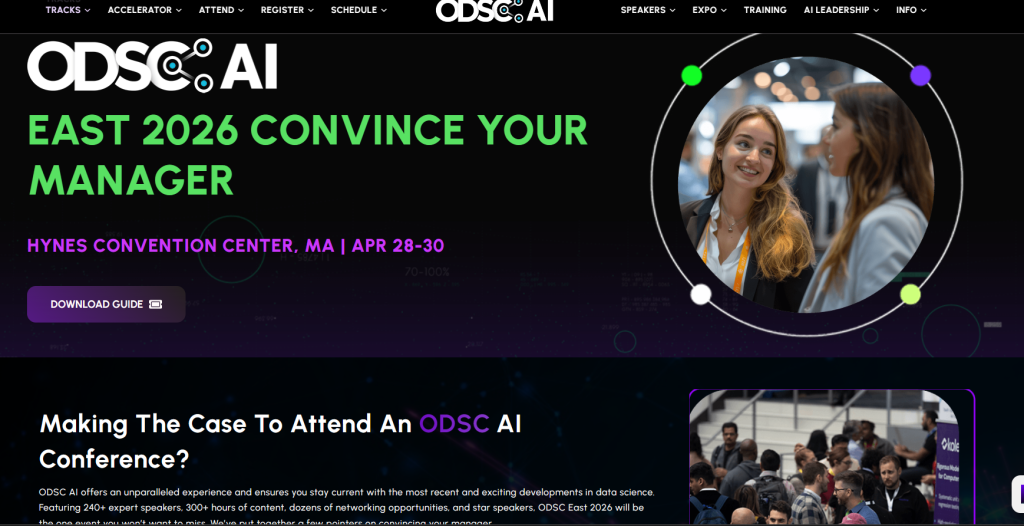
Its “Convince Your Manager” page includes both an attendee email template and a separate guide written specifically for managers. The messaging focuses heavily on practical AI upskilling, hands-on learning, and the organizational impact of keeping technical teams current in a rapidly evolving AI landscape.
The event also emphasizes implementation-focused learning instead of high-level inspiration alone. Training tracks, certifications, workshops, and applied AI sessions are positioned as directly transferable skills attendees can bring back to their teams.
How it stands out
ODSC frames conference attendance as an AI capability investment.
The approval conversation centers on keeping teams current, competitive, and technically prepared as AI adoption accelerates across industries. The addition of separate manager-facing guidance is also notable because it shifts part of the persuasion effort away from the attendee and toward the event itself.
14. HLTH 2026 – The “Bring Your Team” Strategy
HLTH is one of the largest healthcare innovation conferences in the world, bringing together providers, payers, startups, pharma companies, investors, policymakers, and digital health leaders. HLTH USA 2026 takes place November 15 to 18 in Las Vegas and is expected to attract more than 12,000 attendees across the healthcare ecosystem.
What they did differently:
HLTH shifted the attendance conversation away from individual approval and toward team participation.
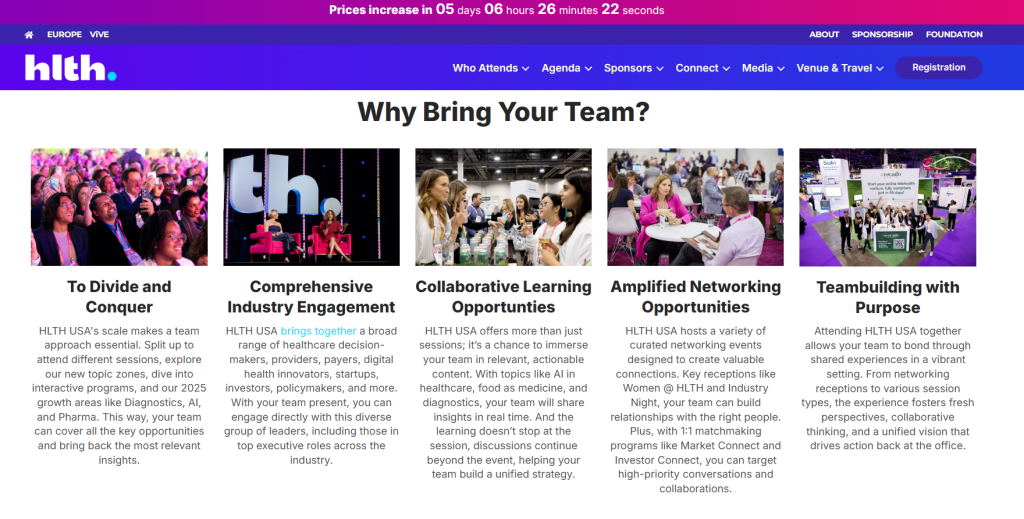
Its Bring Your Team page frames conference attendance as a coordinated organizational strategy designed to accelerate learning, strengthen alignment, and improve decision-making across departments.
The messaging focuses heavily on the idea of “divide and conquer.” Teams are encouraged to split across sessions, networking programs, topic zones, and meetings, then regroup with a broader view of the market, emerging technologies, and industry shifts.
HLTH also emphasizes collaborative learning, cross-functional relationship building, and shared implementation planning after the event. The positioning consistently centers on organizational outcomes rather than individual professional development.
They paired that with a second move built directly into registration:
Instead of sending every visitor to one shared pricing page, HLTH built a Return of Attendance ( tool that walks each attendee through a short, personalized flow before they pick a ticket.
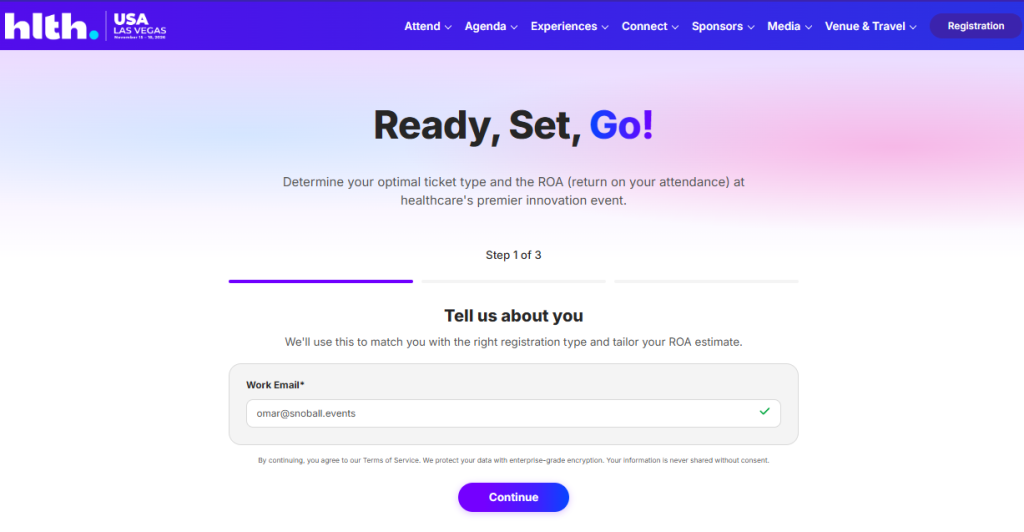
The tool runs in three steps. Step one asks for a work email. Step two asks for organization type, from Health System/Hospital and Health Tech Startup to Payer/Health Plan and Pharma/Life Sciences, plus seniority level from C-Suite down to Individual Contributor. Step three asks for travel region, whether the attendee is an actively practicing clinician, and an optional primary function such as Strategy/Innovation or Business Development/Sales.
Based on those answers, the tool points the attendee to their optimal ticket type and estimates their ROA, HLTH’s term for return on attendance, before they ever have to compare tiers on a generic pricing grid.
How it stands out
HLTH approaches attendance as a shared organizational initiative rather than an individual learning opportunity alone.
The event positions team participation as a way to expand market visibility, strengthen internal alignment, accelerate decision-making, and create shared momentum around healthcare transformation initiatives. That framing makes the approval conversation feel closer to collaborative strategic planning than a traditional conference attendance request.
The Return of Attendance tool carries that same thinking into registration itself. Rather than asking attendees to figure out which ticket fits and what they’ll get back, HLTH collects a few details about their role and travel profile and hands back a specific ticket recommendation and ROA estimate, a number the attendee can take straight into the approval conversation instead of building one themselves.
15. Ai4 — The Data-Backed ROI Case
Ai4 is one of the largest enterprise AI conferences in North America, bringing together executives, AI leaders, data scientists, technology teams, and startups focused on practical AI implementation across industries. Ai4 2026 takes place August 4 to 6 at The Venetian in Las Vegas and features more than 12,000 attendees, 1,000 speakers, and 400 exhibitors.
What they did differently:
Ai4 built an attendance approval experience centered heavily around measurable business outcomes and implementation value.
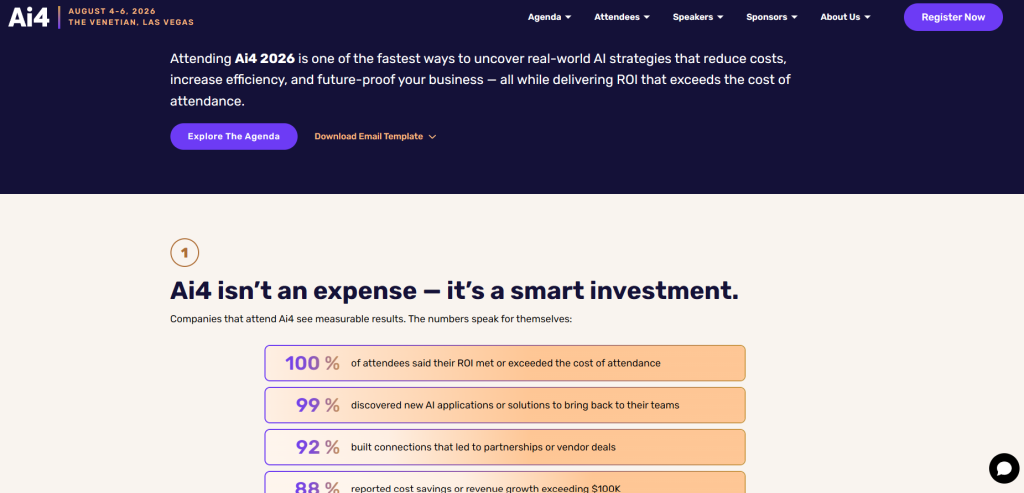
Its “Get Approval to Attend” page combines ROI statistics, executive testimonials, implementation-focused planning, and a ready-to-send approval email into a structured business case for attendance.
The page highlights several attendee outcome metrics prominently, including:
- 100% of surveyed attendees saying the ROI met or exceeded the cost of attendance
- 88% reporting more than $100,000 in cost savings or revenue growth
- 92% forming new partnerships or vendor relationships
- 87% implementing strategies from the event within the short term
The event also encourages attendees to identify the exact sessions, tracks, exhibitors, and AI use cases aligned with their organizational priorities before requesting approval. That shifts the approval conversation toward implementation planning rather than general conference attendance.
Another notable detail is the amount of social proof built into the experience. The page features executive testimonials describing how the conference influenced AI adoption strategies, operational efficiency initiatives, compliance planning, and broader transformation roadmaps.
How it stands out
Ai4 treats attendance approval like an investment memo.
The page combines hard ROI metrics, peer validation, implementation planning, and organizational outcomes into a single workflow that feels much closer to a business proposal than a traditional conference request. The emphasis on measurable impact gives managers a clearer framework for evaluating the value of attendance before budget discussions even begin.
The Bottom Line
The standard convince-your-boss letter is not working hard enough. These 15 events prove there is a better way.
The common thread is ownership. Traditional approval letters put the entire burden on the attendee. These events took that off their plate and built the case themselves. A well-built ROI calculator, a real outcome story, or an AI-generated letter does more persuasive work than any generic template ever could.
AI will push this further. The justify-attendance page is no longer a static PDF. It is becoming a dynamic product built directly into the registration experience.
But the biggest opportunity is still underused: peer influence. No tool is as persuasive as hearing from someone who is already going. Events that activate their attendees as advocates during registration have the potential to turn their own attendee base into their strongest approval channel.