

I took the train down to DC. Six hours, which sounds worse than it is. You get a window, a table and nobody asking you anything, so I cleared a pile of work, watched a good chunk of the northeast go past, and spent a long stretch of it thinking about our first ever Event Marketing Lab.
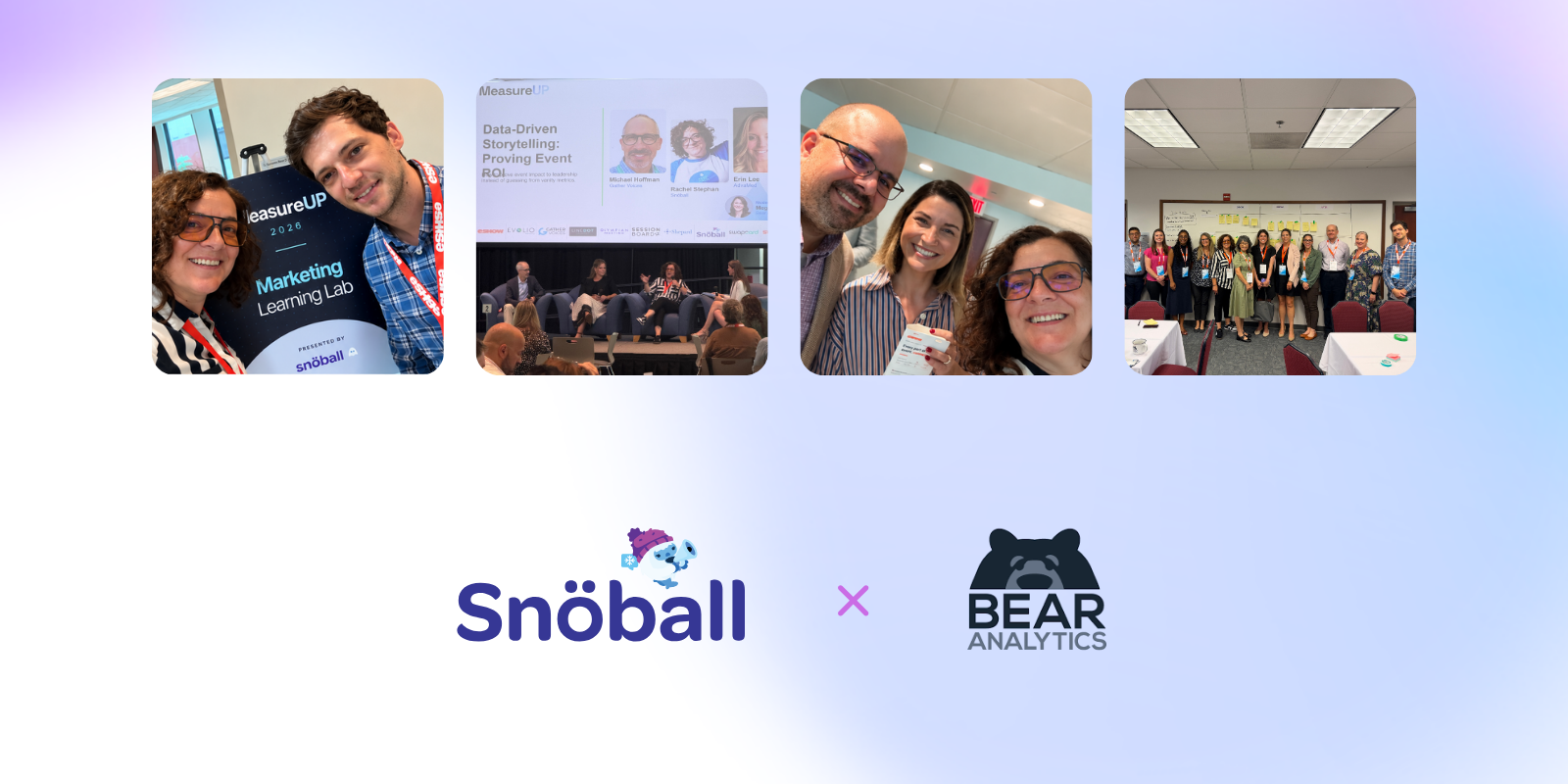
MeasureUP is Bear Analytics’ one-day conference on event data, and this year it landed on 2 September at the National Housing Center in Washington DC. Snöball went as a partner, and Rachel Stephan and I had the afternoon’s Marketing Learning Lab to run. The banner in the lobby promised AI and data analytics.
Whatever I pictured on the way down, the day had its own ideas, and I mean that as a compliment.
Right before we broke for lunch, Megan Martin wrapped the ROI panel and told the room what was coming: “This was all foundational conversations. And then we’re going to apply all that in the afternoon with our learning labs.” Most one-day conferences hand you the answers and send you home. Bear built this one so the morning raised questions and the afternoon handed them back to the people in the room, which meant that by four o’clock there were answers up on a wall in somebody else’s handwriting.
Rachel was on that panel too, a few hours before we ran the lab.


The morning
Things opened with Show Floor Show Down, where David T. Stevens of Olympian Meetings, Carly Heideger of RX and Megan Martin got into something a lot of teams have quietly stopped trying to fix. Exhibitors decide whether to buy a booth on one set of criteria, and the rebooking process organizers build sits on a completely different one, so those conversations go nowhere and exhibitors cannot assemble the numbers they need to justify the spend upstairs. Nobody on that stage claimed to have solved it. Worth holding onto anyway, because it turns up again about four hours later.
Then Joe Colangelo and Sean Wargo of Apogee Insights did a fireside on which data is even worth collecting in the first place, and how AI changes the value of whatever you have already got sitting there. The line I wrote down was that most event teams are not short of data at all. They are short of one number they trust enough to actually act on.
Brian Scott, Michael Weisenburg and Scott Lock followed on AI as infrastructure. Security, permissioning, the plumbing that has to be in place before anybody builds anything clever on top of it. Not the flashiest half hour of the day and probably the one that saves somebody in that room a genuinely bad quarter.
The panel
Megan opened the ROI panel by naming something most event marketers are quietly managing around. Content is the most under-measured tool in the kit, and the internet is getting messier by the week, to the point where, as she put it, “LinkedIn itself has the AI slop button now.” Which is the whole argument for a real person’s voice, and she framed it better than I would have. This is the golden era of events, because “the only place to know if it’s real or true is if you saw it for yourself.”
Then Erin Lee, SVP of Marketing Strategy & Growth at AdvaMed, told a story that starts somewhere most people would not start, which is with her own staff.
AdvaMed’s work covers a lot more ground than its conference, and Erin’s read was that the people closest to the industry were the most underused voice it had. So the first campaign did not go out to influencers. It went to the member-facing staff who are on the phone with the industry every day, on the fairly simple logic of working out who already has reach on LinkedIn and starting there.
That earned some internal trust, and then a stretch of the program got harder. A segment of the speakers they had counted on became unavailable and a chunk of subject-matter expertise came off the agenda at once.
“And I was like, who do we have? We have staff.”
Erin Lee, AdvaMed
The AdvaMed in Action campaign that came out of that, built on Gather Voices to capture the video and Snöball to distribute and attribute it, became the association’s second most successful campaign. LinkedIn engagement went up 77% year over year, the conference is up 25% in two years, and Erin puts engaged leads up roughly 25% as well, though she was careful not to hand the credit to any single thing: “There’s not one silver bullet.”
Michael Hoffman of Gather Voices made the case for building from the bottom up rather than the top down, on the grounds that everybody is an influencer inside their own community and a peer will often outperform somebody with actual reach. “I don’t need Kim Kardashian to tell me to go to The MedTech Conference.” His better point was about what the asking does to the person being asked: “when somebody articulates why they care about something, it changes how they care about it.” You get the content and you also get somebody who is a little more invested in the thing than they were an hour ago.
Gather Voices had a story booth running in the hall all day, and Michael mentioned a number off the back of it that I have been thinking about since. Roughly 90% of the people who stop and tell their story will opt in to being asked again later in the year.

Rachel picked up where that content actually goes and what you can learn by watching it travel. Every shareable asset you put in a speaker’s or a sponsor’s hands is uniquely trackable, which means you know how many people they referred, who those people were, and which channel the share moved through. That last part is the one that surprises rooms. After LinkedIn, the highest-attributing channel is dark social, meaning email, WhatsApp, Teams and private communities. “That’s where they’re most trusted, because it’s in the close circle.”

The afternoon
About forty event marketers came through the Marketing Learning Lab after lunch.
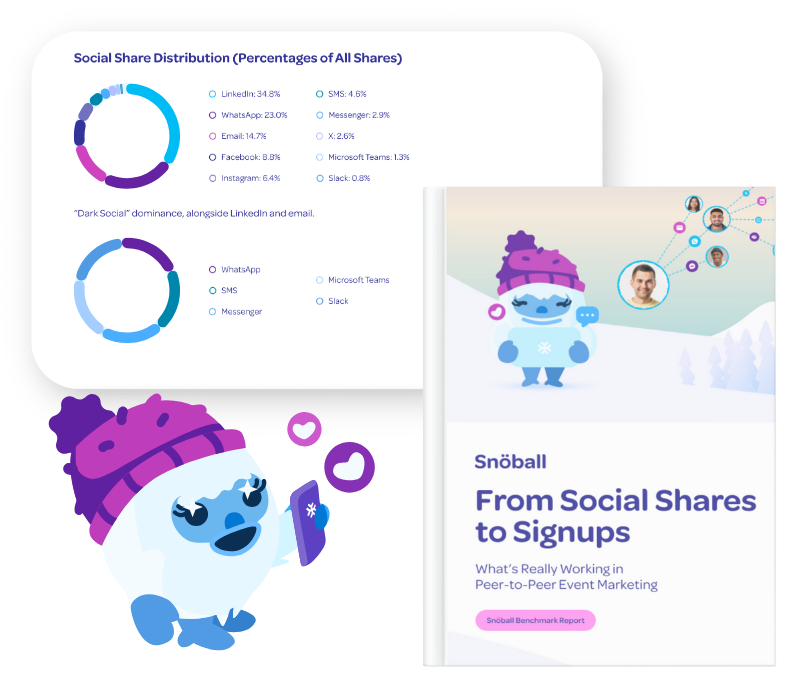
It started with 31.9% written up on the whiteboard, which is the share-to-signup number out of our benchmark report and the reason we think any of this is worth an afternoon. Activate the people who already belong to your event and they will hold their own against the channels you are paying for.
Then we stopped talking, which was the actual plan. Knowing the number does not get anybody anywhere. What we wanted was for each table to work out what standing this up would really involve at their own organization, for the advocate groups they have already got sitting there. So we taped those four groups across the wall, handed out markers, and asked four questions. What’s the ask? What do they need? What’s the hurdle? And how would you measure it?
Everybody wanted the same thing. Four rows, different tables, and under what do they need every one of them gave a version of the same answer, which was do the work for them. A finished asset. Graphic sized, caption drafted, link built, everything except the one line only that person can write.
“No time” turned out to be a decoy. Time got named as the hurdle in every single row, but the second line each table wrote underneath it tells you what is actually going on. Nobody had explained why it was worth doing and there was nothing in it for them.
The currency was not money. Somebody floated a gift-card draw and the room talked them out of it inside a minute. What they wanted instead was status and access, which in practice meant expo passes, being named as selected to speak, and time with a person you cannot otherwise get to.
Then the morning came back around, which was my favourite thing that happened all day. The idea that got the most agreement all afternoon was to let the exhibitors who drive the most registrations pick their booth first next year. It costs the organizer nothing and gives the exhibitor something they genuinely want and cannot buy. It came from a table that happened to seat both an exhibitor and an event organizer, the same two sides Show Floor Show Down had described talking past each other that morning, and between them they worked it out in about ninety seconds with one marker.
The measurement question produced the sharpest thing anybody wrote all day. Most tables reached for reach, meaning impressions and engagement and traffic. A few reached for something you can count back to one person. And one table put the entire problem down as its hurdle, in seven words.
“Was the promotion because of the guide.”
Written on a card, Marketing Learning Lab
They had given their speakers a guide on how to promote themselves, some speakers posted, and there was no way to tell whether the guide had anything to do with it. Nobody at that table needed it explained to them.

Where AI actually fit
At a conference about agentic AI, the most interesting part of the AI question turned out to be what nobody asked for. We put it to every group. Where would you use AI to get over the hurdle you just named? Not one table said write my social posts for me.
What they wanted was AI at the hurdle rather than at the tactic. Prompt the advocate instead of replacing them. Turn somebody’s own event data into a recap they would actually want to post. Run the analysis on the results afterward rather than on the content beforehand. Where the blocker was a blank page or effort or analysis they wanted the help, and where the value was somebody’s real voice they did not, which lines up with how Rachel had described the point of the whole thing a few hours earlier on the panel: “It’s all about trust. It’s all about people. And we’re here to amplify their voices.”

What we published
We wrote up everything the room produced. Five findings with the reasoning built out, twelve ready-to-send asks with the copy already written, and five ways to attribute a registration back to a person without buying anything to do it.


Thank you to Bear for having us, and to everyone who picked up a marker.
Ian Davis, VP Marketing, Snöball
Snö on the Ground is what we call it when we pack up and go to an event. More of these as we go.
Free PDF guide
What the Room Built
Everything the Marketing Learning Lab produced, written up. Five findings, twelve advocate asks with the copy already written so you can paste and send them, and five ways to attribute a registration back to a person. Enter your email below and it opens right here.