

The data points to an engagement gap. Conversations with association leaders — including practitioners we spent two days with at ASAE’s last annual meeting — point to the fix.
Snöball.Events | May 2026 | 14 min read
TL;DR — KEY ANSWERS AT A GLANCE
|
Ask any membership director what keeps them up at night, and the answer is almost always the same: the gap between how many members you recruited and how many you actually kept. For nonprofits, that gap isn’t just a revenue problem — it’s a mission problem. Every member who quietly lets their membership lapse is a person who once believed in what you’re doing and then, somewhere along the way, stopped feeling it.
We spent two days at ASAE’s last annual meeting with a camera and a lot of questions — talking to association professionals at every level, from small-staff nonprofits to leaders of some of the largest associations in the country. The same themes kept surfacing, not as conference platitudes but as real operational pressure that membership directors feel every quarter. What follows draws on those conversations, the documentary we built from them, and the research that backs it all up.
84% Median overall renewal rate for associations MGI 2025 Benchmarking Report | 74% First-year renewal rate — a full 10 points lower MGI 2025 Benchmarking Report | 50% Of associations report no growth or decline MGI 2025 Benchmarking Report |
Those numbers tell a precise story. The 10-point gap between overall and first-year renewal rates isn’t a coincidence — it’s a symptom. New members leave at higher rates because most organizations haven’t built a systematic way to make them feel like they belong before renewal day arrives.
Why do nonprofit members stop engaging with their association?
The uncomfortable truth is that most member attrition isn’t caused by dissatisfaction. It’s caused by indifference. People don’t leave angry — they leave distracted. And that distinction changes everything about how you approach retention.
Arianna Rehak, Co-Founder & CEO of Matchbox Virtual Media, put the attention challenge directly: “Everyone has so many things pulling for them and vying for their attention. Associations are competing with lots of different ways people are getting information, getting education, learning from each other.”
The competition for member attention isn’t just from other associations. It’s from LinkedIn, Patreon, YouTube channels, Slack communities, and a hundred other places offering peer connection and professional learning for free. Artesha Moore, FASAE, CAE, President & CEO of Association Forum, put the challenge plainly:
“Monetized community membership has been dead for 20 years when LinkedIn made it free. The idea that we’re still struggling to modernize our membership models and figure it out is a losing proposition.”
Artesha Moore, FASAE, CAE, President & CEO, Association Forum
Part of what makes disengagement so persistent is that many associations are still leading with legacy offerings — products built for members’ needs a decade ago. Reggie Henry, CAE, ASAE’s Chief Information & Performance Excellence Officer, named this as one of the most overlooked retention risks: “As we produce more products and services, it becomes really important to sell those products and services. Whereas when we first developed them, they were developed with the members’ needs in mind. And sometimes members’ needs changed — which means those products and services that we’re trying to sell so hard might not be the products and services they need.”
The answer isn’t to charge less or produce more. It’s to stay closer to what members actually need — and to treat keeping them as seriously as you treat recruiting them. As Jana Darling, President of MGI, put it plainly:
“Retention to me is the most important thing. If you study marketing courses, it’s always easier to retain a member than it is to get a new one.”
Jana Darling, President, Marketing General Incorporated (MGI)
Why is first-year member retention lower than overall retention?
The single most consistent thing we hear from practitioners: the decision to renew is made long before the renewal notice arrives, and it’s largely made in the first month of membership. First-year renewal rates lag because most organizations treat onboarding as an administrative step rather than the foundation of the entire membership relationship.
“Day one is the day that you need to start working on how you’re going to retain them. How are you engaging them? Do you have an onboarding strategy? Are you sending welcome emails? Are you doing welcome calls? Are you inviting them to your community? Do you do new member webinars that show them how to use their benefits? Because that first 30 to 60 days are probably the most critical — and if you don’t get them to engage with you early on, the likelihood of them renewing becomes lower.”
Jana Darling, President, MGI
What the data shows: According to MGI’s 2025 benchmarking research, 52% of members who don’t renew cite a lack of engagement with the organization as the primary reason — ahead of budget constraints, job changes, or dissatisfaction. Engagement is preventable attrition. It also means the solution is largely within your control.
Vinnu Deshetty, Founder and Event ROI Coach, reframed how most organizations think about the member journey: “It’s really important, especially in the event world, to understand that the event journey doesn’t begin on site — it begins when they are interested in the association. How do they become a member? How do you get them interested in your events?” That framing applies equally to membership itself. The onboarding journey starts the moment someone considers joining, not when they receive their welcome email.
The goal isn’t to overwhelm new members with information. It’s to give them one meaningful win before they’ve had time to slip into passivity. Once a member is passive, re-engagement is expensive. Prevention costs almost nothing by comparison.
What does a high membership renewal rate actually look like in practice?
The best retention outcome isn’t a member who renews reluctantly. It’s a member who doesn’t even pause when the invoice arrives. The goal of year-round engagement is to make renewal so obvious it barely registers as a decision.
“If you’re constantly engaging them throughout the year, to me when it comes time to the renewal, the renewal is then simply a transaction — because they’re so embedded in your organization, they become so reliant on everything that you offer that it’s not even something that they need to think about. They get an invoice and they pay it because it’s something they need to succeed in their career.”
Jana Darling, President, MGI
This reframe matters. Most organizations orient their retention work around the renewal window — the 60 days before expiration, the reminder sequence, the last-chance offer. That work is necessary but insufficient. Organizations with strong first-year renewal rates do something different all year: they create moments of value that compound. The renewal is the conclusion of a story that’s been told all year, not the beginning of a campaign.
How can associations personalize the member experience at scale?
One word came up in nearly every conversation at ASAE: personalization. Not as a buzzword, but as a real operational gap between what members expect and what most organizations deliver.
“Members are saying: why can’t I get this from my association? My association should know who I am. I have a member profile. They know what sessions I’m going to — so cater to me in some way that makes sense to me. Make it easy for me to find sessions, find content. Speak to me as someone that you know.”
Vinnu Deshetty, Founder & Event ROI Coach
Artesha Moore pointed to where this is heading: “The more that we can say, hey, you specifically with that shirt on, this is for you — the more that we can harness this is the value that we bring to you specifically — that’s what will get your attention.” AI-driven hyper-personalization is arriving faster than most associations are ready for it. The organizations that will win on retention are the ones building those personalization muscles now.
Personalization at scale doesn’t require a massive tech overhaul to start. It begins with segmentation — using what you already know. Career stage, interests, event history, content consumption — the signals are usually already in your AMS. Jana Darling described working with an organization that had sent six emails before noon because they did zero segmentation. Unsubscribes were through the roof. Members weren’t getting what they wanted — they were getting what other members wanted.
How does peer-to-peer engagement improve membership retention?
One of the most durable retention drivers is also one of the most underused: the members themselves. MGI’s benchmarking data consistently shows peer-to-peer referrals are among the most effective new-member recruitment channels — and Jana Darling noted that the model is evolving in an important direction:
“Member get a member programs — that is still one of the top reasons when people say what are their most effective new member recruitment channels. I think now it’s more organic. Social media and the influencer has kind of changed that — how people are using the ambassadors of their organization to speak to the value.”
Jana Darling, President, MGI
The shift from formal referral programs to organic ambassadorship matters for retention, not just recruitment. A member who publicly advocates for an association — who shares, posts, refers, and represents — is a member who has made their engagement visible. Visibility creates accountability. It’s much harder to quietly let a membership lapse when your colleagues know you as someone who champions that organization.
“Our members want to talk to each other more than they want to talk to us. Providing them the space to do that — and then getting out of the way — is one of the most important things we can do.”
Reggie Henry, CAE, Chief Information & Performance Excellence Officer, ASAE
Brudis Limar III, CMO of Showcare offered the most vivid framing for what this looks like at its best:
“The most successful product companies transitioned their users into superheroes. And then these people became the voice of the company by itself without working for the company. I do believe that associations have a very interesting angle to look at here — because at the end, we all talk about people. It’s all about people.”
Brudis Limar III, Chief Marketing Officer, Showcare
The superhero framing isn’t just a metaphor — it’s a design principle. When a member earns a certification, attends your flagship event, or reaches a milestone, the question isn’t just “do they know about it?” It’s “does their network know about it?” Associations engineering those sharing moments are the ones turning engaged members into visible advocates — and visible advocates into a retention flywheel.
The most forward-thinking associations are building peer-to-peer moments deliberately across the full member lifecycle:
PEER-TO-PEER MOMENTS THAT DRIVE RETENTION
|
How do you keep members engaged between annual events?
One of the most underexamined retention risks in the association world is the gap between events. Most associations communicate heavily in the run-up to their annual conference, then go quiet. Members who experience that silence — who feel the association only exists for them when there’s something to sell — are exactly the members who don’t renew.
“What’s really important is to think about that phase of delighting your members — going beyond waiting for the next event to communicate with them. It’s really about finding valuable activities in between events instead of just relying on events for your main revenue of the year.”
Brudis Limar III, Chief Marketing Officer, Showcare
Vinnu Deshetty made a similar point about the continuity of the member experience: “We’ve got conferences, we’ve got publications, we’ve got social media communities — all of these different things that kind of live in their silos. What’s the common thread to bring it all together and give a more holistic, comprehensive experience to the member?” That thread is the between-events strategy most associations haven’t fully built yet.
The practical answer involves a few levers working together: community platforms that give members a reason to show up and talk to each other outside of event season; content that arrives between events with the same quality and personalization as event programming; and peer-to-peer touchpoints — certification announcements, milestone recognitions, referral moments — that keep the social dimension of membership alive even when no event is on the horizon.
Reggie Henry described what ASAE found when they looked at their own community data: “The most often asked questions were about how to buy or use a particular tool — practical, immediate, peer-driven conversations. Our community is vibrant. It’s one of the most used of all of the resources we have at ASAE.” The lesson is that members don’t need the association to entertain them between events. They need the association to get out of the way and let them help each other.
What member data should associations track to predict churn?
The retention organizations that consistently outperform share one trait: they treat every member interaction as a signal. Not just transactions — not just renewals and event registrations — but every touchpoint. Who opened what. Who attended. Who referred someone. Who went quiet.
“The use of data — not only from a transactional point of view, but from an every interaction point of view. Organizations realizing that all of those interactions matter and can be the basis for personalization of all kinds of member engagement.”
Reggie Henry, CAE, Chief Information & Performance Excellence Officer, ASAE
The practical implication is early warning. If a member goes quiet — no event attendance, no content engagement, no community participation — that’s a signal worth acting on weeks before the renewal notice would have arrived. By the time the invoice lands, the decision is often already made.
Jana Darling added a note of urgency specific to the current moment: MGI’s mid-year survey found a 10% drop in associations seeing membership increases, with many moving to flat or declining. “My one piece of advice is: you have to keep marketing. People now more than ever need their associations. They need to hear about you, they need the value that you provide, but they simply are not just going to find you on their own.”
The cost of doing nothing: Acquiring a new member costs 5–7x more than retaining an existing one. An association with 1,000 members at 80% retention needs 200 new members just to stay flat. At 90% retention, it only needs 100 — half the acquisition effort for the same result. Retained members also generate additional value through events, non-dues revenue, referrals, and volunteer leadership. Each 1% improvement in retention has a compounding effect that recruitment alone can never replicate.
What do high-retention associations do differently?
After two days of conversations at ASAE and the benchmarking data to back it up, a clear pattern emerges. High-retention organizations don’t have a single secret tactic. They have a consistent culture built on a handful of fundamentals — applied deliberately rather than occasionally.
They treat day one as the most important day of the membership. A structured onboarding sequence — welcome emails, a community invitation, a benefit walkthrough, ideally a personal touchpoint — isn’t a nice-to-have. It’s the foundation of everything that follows. They personalize by behavior, not just demographics. They build a between-events strategy that keeps members connected to each other and to the organization even when there’s nothing to sell. They create peer-to-peer moments deliberately — engineering opportunities for members to share their involvement, celebrate their credentials, and advocate within their networks. And they treat the renewal as a conclusion, not a campaign. By the time the renewal notice arrives, the work is already done.
None of this requires new technology to start. What it requires is the discipline to treat retention as a year-round culture rather than a quarterly tactic — and the willingness to measure what’s actually working.
The bottom line: Retention is the accumulated result of every experience a member has with your organization, starting the day they join. Build engagement into the first 30 days. Make personalization a system, not a one-off. Stay present between events. Create the conditions for members to publicly identify with your organization, share their milestones, and bring their peers along. Do those things consistently, and the renewals take care of themselves. |
Frequently Asked Questions
Direct answers to the questions association professionals ask most.
What is a good membership retention rate for a nonprofit association?
A good membership retention rate for a nonprofit association is between 80% and 90%. According to MGI’s 2025 Membership Marketing Benchmarking Report, the current industry median overall renewal rate is 84%. First-year renewal rates are typically lower — the 2025 median is 74% — making new member onboarding the highest-leverage area for improvement. Associations with strong engagement programs regularly achieve renewal rates above 90%.
What is the most common reason members don’t renew their association membership?
The most common reason members don’t renew is a lack of engagement with the organization — not budget constraints or dissatisfaction. MGI’s 2025 research found that 52% of non-renewals cite disengagement as the primary cause. This means the majority of lapsed memberships are preventable with the right year-round engagement strategy, rather than being lost to factors outside the association’s control.
When should associations start focusing on member retention?
Associations should start retention efforts on day one of a member’s joining — not in the weeks before renewal. The first 30 to 60 days of membership are the most critical window for establishing the habits and connections that drive long-term renewal. Organizations with a structured onboarding sequence — welcome emails, community invitations, benefit walkthroughs, and early engagement touchpoints — see meaningfully higher first-year renewal rates than those relying on renewal campaigns alone.
How much does it cost to acquire a new member vs. retaining an existing one?
Acquiring a new member costs approximately 5 to 7 times more than retaining an existing one. An association with 1,000 members needs 200 new members per year just to stay flat at 80% retention, but only 100 new members at 90% retention — half the acquisition cost for the same result. Retained members also generate additional value through events, non-dues revenue, referrals, and volunteer leadership.
How do you keep association members engaged between annual events?
Keeping members engaged between events requires a deliberate between-events strategy, not just increased email volume. The most effective approaches include maintaining an active peer community platform where members can ask questions and share knowledge; delivering personalized content that arrives with the same relevance as event programming; and creating peer-to-peer moments — certification announcements, milestone recognitions, content sharing — that keep the social dimension of membership alive year-round. Associations that treat annual events as their primary engagement mechanism are structurally vulnerable to lapse, because members who only feel connected during conference season have no reason to renew outside of it.
What is peer-to-peer marketing and how does it help with association membership retention?
Peer-to-peer marketing in the association context means activating engaged members to share, refer, and advocate within their professional networks — rather than relying solely on organization-to-member communications. For retention specifically, peer-to-peer moments work because they deepen a member’s public commitment to the association. When a member shares they’re attending an event, announces a certification, or refers a colleague, they are reinforcing their own identity as a member — which makes non-renewal psychologically harder. Associations that engineer these moments deliberately see stronger retention alongside the recruitment benefits.
How can associations use data to improve member retention?
Associations can use interaction-level data — not just transactional data like dues payments and event registrations — to identify at-risk members before they lapse. Key signals include declining email engagement, absence from events, reduced community participation, and no content consumption over a defined period. When these patterns appear weeks or months before a renewal date, proactive outreach is far more effective than a last-minute renewal campaign. The most effective associations also use behavioral data to personalize communications by member interests, career stage, and engagement history.
What is the average first-year renewal rate for associations?
According to MGI’s 2025 Membership Marketing Benchmarking Report, the median first-year renewal rate for associations is 74% — compared to an overall median renewal rate of 84%. This 10-point gap reflects the challenge of engaging new members before they form habits and connections with the organization. Closing that gap through structured onboarding and early engagement would have a greater impact on total membership than most recruitment campaigns.
About Snöball
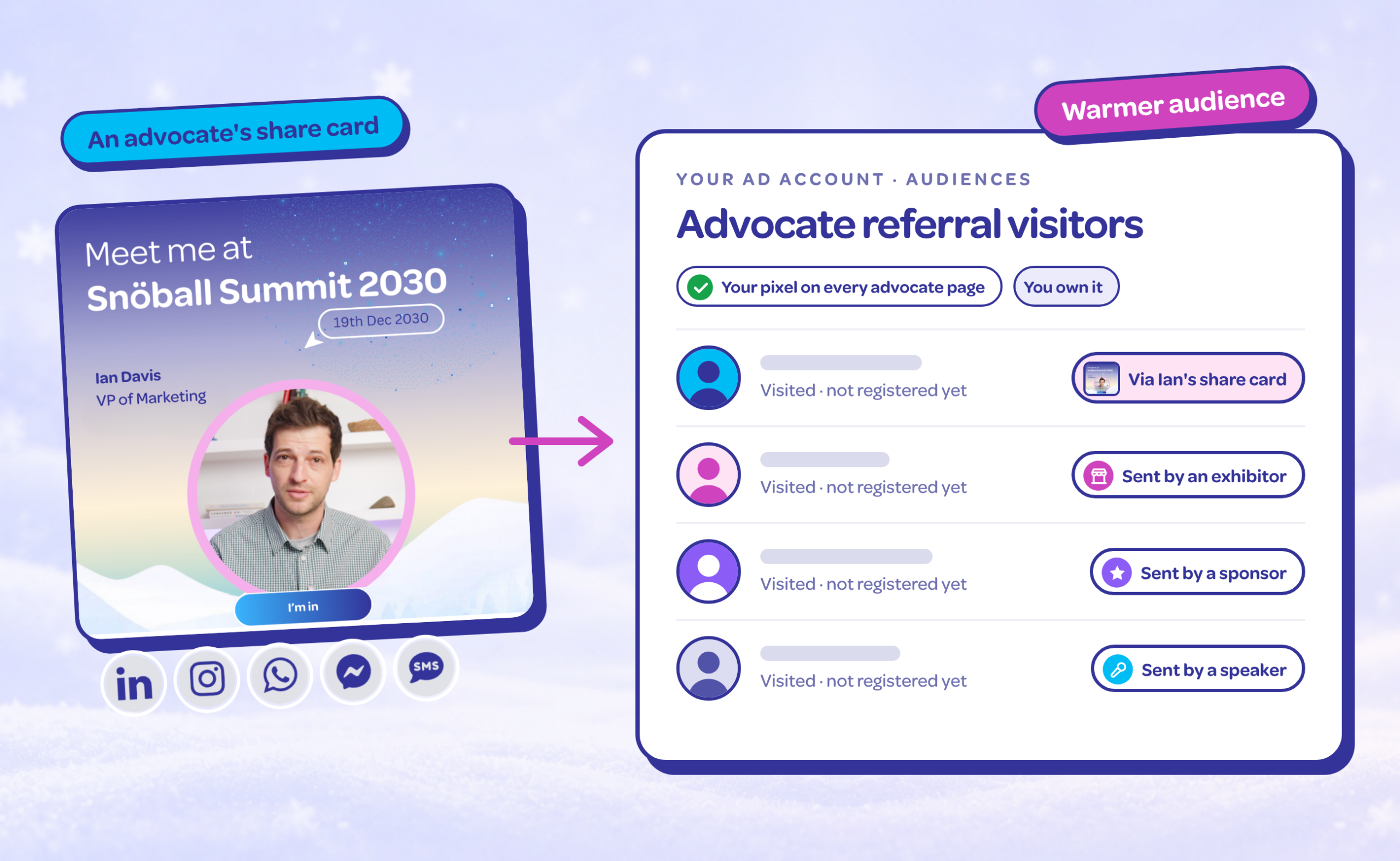
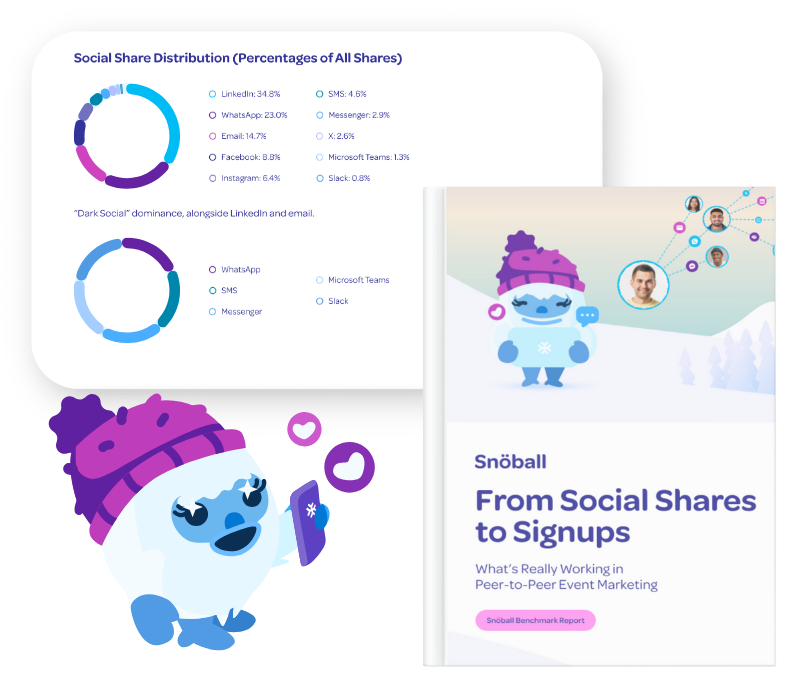
Snöball is the peer-to-peer event marketing solution that turns attendees, speakers, sponsors, and exhibitors into your most powerful growth channel. Fully managed campaigns make it easy for participants to share personalized event content across 17+ channels — LinkedIn, Instagram, WhatsApp, email, SMS, Slack, Teams — with a strong focus on high-converting “dark social.” Advocate-driven traffic converts at an average 31.9% share-to-sign-up rate, delivering qualified registrations and ROI measurable down to the person and channel. As the only SOC 2 Type II certified peer-to-peer event marketing solution, Snöball helps organizers scale trusted growth across global conferences, associations, and corporate programs.