
Top 4 Monetization Opportunities in Peer-to-Peer Event Marketing
Increasing revenue is a priority for almost every event organizer. But while peer-to-peer (P2P) marketing is usually viewed as a way to drive registrations, it can do more than grow attendance.
Your attendees, speakers, exhibitors and sponsors are already connected to people who could be interested in your event. When you give them personalized content and easy ways to share, those relationships become a measurable marketing channel.
That activity also creates sponsorable touchpoints that can generate additional value for your event.
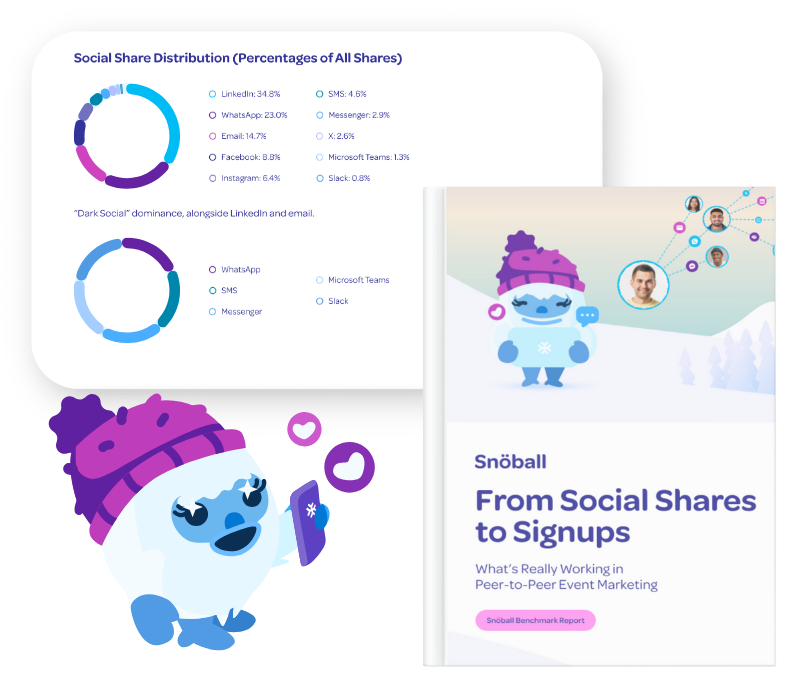
The 2026 Snöball Peer-to-Peer Benchmark Report found that 31.9% of organic peer shares convert into registrations, with top-performing campaigns reaching 53.7%. On average, P2P referrals account for 6.9% of total event attendance, rising to 13.2% among top-performing events.
So if your P2P campaign is already helping generate registrations, why not explore ways to monetize the activity too?
Here are four opportunities to consider.
1. Monetize Sponsored Social Sharing
One of the simplest ways to introduce sponsorship into a P2P campaign is through the share cards your advocates use to promote your event.
An attendee might share that they’re attending. A speaker might promote their session. An exhibitor might invite their customers to visit their booth.
These personalized share assets can carry sponsor branding, putting the sponsor’s logo or name alongside content that attendees and other advocates are actively sharing.
How to monetize it
Event organizers can offer sponsors visibility on:
- Attendee share cards
- Speaker share cards
- Exhibitor promotional content
- Other personalized advocacy assets
The sponsor’s branding appears alongside an event-related recommendation from someone within the event community.
And because Snöball supports sharing across 17+ channels, including LinkedIn, email, WhatsApp, SMS, Slack and Teams, sponsored content can reach audiences beyond the event’s owned channels.
Why it works for sponsors
Traditional sponsorship often puts a brand in front of an audience. P2P sponsorship places that brand alongside content being shared by members of the event community.
That gives sponsors another way to participate in event promotion while giving organizers a sponsorable campaign asset.
2. Monetize Sponsor-Funded Promo Codes
Registration discounts can give people a practical reason to share an event.
An advocate can receive a personalized promo code and share it with their network, giving their contacts a tangible reason to register.
The same promo code can also create an opportunity for a sponsor.
A sponsor can fund the discount behind the offer, associating its brand with something that advocates are actively sharing.
How it works
For example:
Use code BRANDNAME for $X off your registration.
The sponsor gets brand association with the offer, while the advocate has something useful to share with their network.
There is another benefit for the organizer: attribution.
When promo codes are linked to individual advocates, organizers can see which speakers, exhibitors, attendees, sponsors or other advocates are generating registrations. That provides a clearer picture of campaign performance and can contribute to sponsor reporting.
Why it works
It’s a straightforward value exchange:
The attendee gets a benefit.
The advocate gets something useful to share.
The sponsor gets visibility.
The organizer gets registrations and campaign data.
The promo code becomes a trackable part of the P2P campaign, giving organizers another way to connect advocacy activity with registrations.
3. Monetize Campaign Email Placements
Email is another natural touchpoint for P2P sponsorship.
A P2P campaign can send personalized emails to attendees, speakers and other advocates, giving them the content and links they need to promote the event to their networks.
Those campaign emails can also provide direct sponsor visibility.
How to monetize it
A sponsor can receive banner placement or other agreed branding within the campaign email.
This gives the sponsor direct exposure to an audience that is already engaged with the event, while the email continues to activate advocates.
For example, the same sponsor could appear:
- On personalized share cards
- In the registration offer
- In the campaign email
This creates visibility across several touchpoints within the same P2P campaign.
Why it works for sponsors
The sponsor’s brand appears within a campaign designed to mobilize the event community and generate registrations.
That connects the sponsorship directly to an active event-marketing initiative rather than a standalone communication.
4. Turn Your P2P Campaign Into a Revenue Opportunity With Snöbank
The first three opportunities involve sponsor visibility across individual P2P campaign touchpoints.
Snöbank takes the idea a step further.
What if a sponsor could fund the incentive behind the campaign?
That’s the idea behind Snöbank.
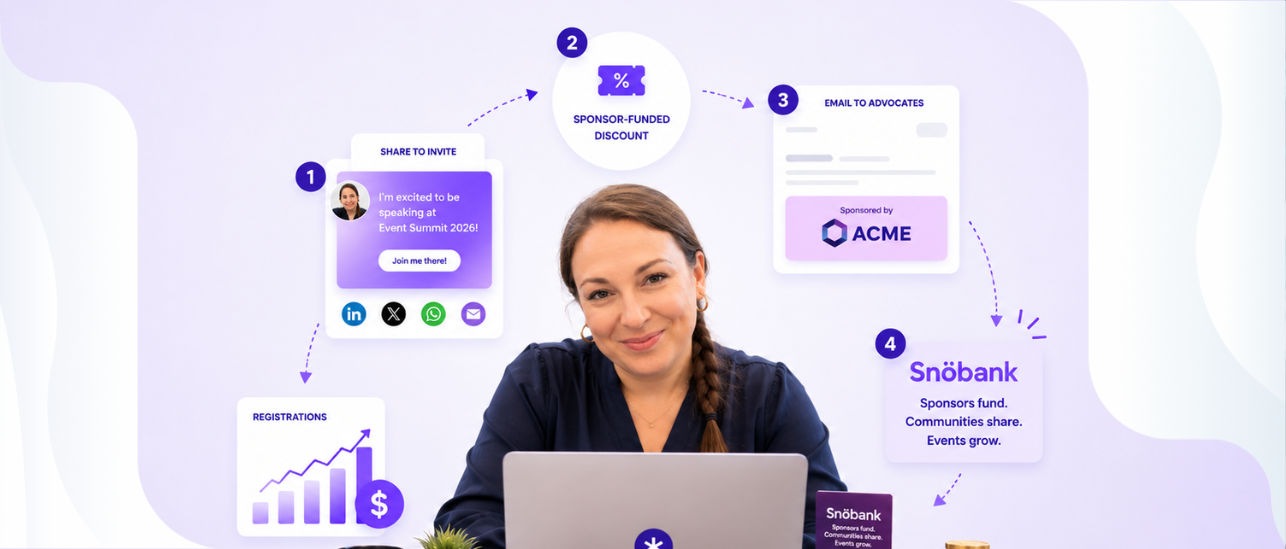
Snöbank allows a sponsor to fund the discount that powers a Snöball peer-to-peer campaign. In return, the sponsor’s branding appears across key campaign touchpoints.
The model is simple:
Sponsor funds the discount → advocates share → peers receive the offer → registrations increase → sponsor gets visibility → organizer creates a new revenue opportunity.
Snöbank is designed to work with Snöball’s peer-to-peer campaigns, bringing the sponsored incentive and campaign visibility together.
What does the sponsor get?
A Snöbank sponsor gets visibility in three key places:
Share cards
The sponsor’s logo appears on attendee and speaker share cards distributed through social and other sharing channels.
The promo code
The sponsor’s name is incorporated into the discount code, associating the brand directly with the registration offer.
Campaign email
The sponsor receives banner visibility in the campaign email sent to registrants and speakers.
Together, these touchpoints give the sponsor exposure through peer-driven sharing and direct campaign communication.
What does the organizer get?
With Snöbank, the sponsor funds the discount behind the campaign, giving the organizer a way to incorporate the registration incentive into a sponsorship opportunity.
The unique promo code also makes the sponsored offer trackable, giving organizers data they can use to demonstrate campaign activity and results.
The P2P campaign continues to drive registrations while the sponsorship creates an additional commercial opportunity around it.
Why Snöbank is different
The first three opportunities monetize individual P2P touchpoints.
Snöbank brings those touchpoints together around a single sponsor-funded campaign.
Rather than offering a sponsor one isolated placement, organizers can give the sponsor a role across the campaign’s share cards, registration offer and email communication.
Learn more about how Snöbank works.
What Does P2P Monetization Look Like in Practice?
The commercial value already being generated by P2P campaigns provides useful context for organizers considering these opportunities.
G2E 2025: 51.5% Share-to-Sign-Up Rate
G2E 2025 mobilized 15,780 gaming professionals through peer-to-peer advocacy, with 1,228 additional registrations.
The campaign generated 2,001 social shares, 2,384 referral CTAs and 10,514 landing page views, with a 51.5% share-to-sign-up rate.
The results show the scale of activity that a well-executed P2P campaign can generate.
DTECH 2026: $365K in Visitor Revenue
DTECH 2026 mobilized 11,642 energy professionals through P2P marketing and generated 1,956 additional registrations.
The campaign contributed an estimated $365,000 in visitor revenue.
For organizers considering sponsorship, this demonstrates the commercial value that can sit behind the P2P activity being monetized.
Gulfood 2026: $1.17M in Projected Visitor Revenue
Gulfood 2026 generated 31,966 referrals and 38,645 social shares, driving an estimated 3.5% of total event registrations
These results give organizers a stronger basis for demonstrating the value of the P2P channel when discussing sponsorship opportunities.
What Can You Offer a P2P Sponsor?
The exact sponsorship opportunity will depend on your event, audience and existing commercial model, but Snöball’s P2P campaigns provide several concrete touchpoints.
| P2P touchpoint | Sponsor value | Organizer value |
|---|---|---|
| Share cards | Brand visibility alongside peer recommendations | A sponsorable campaign asset |
| Promo codes | Brand association with a registration benefit | Trackable registration activity |
| Campaign emails | Direct visibility to registrants and speakers | Additional sponsor inventory |
| Snöbank | Sponsor-funded incentive plus visibility across campaign touchpoints | Potentially offset campaign cost while creating a revenue opportunity |
The key is to keep the sponsor connected to the P2P activity without overwhelming the content.
The advocate remains the voice, the event remains the subject, and the sponsor supports the campaign.
Don’t Turn a Peer Recommendation Into an Advertisement
P2P relies on people sharing event content with their own networks. Sponsor branding should complement that content rather than dominate it.
The hierarchy should remain clear:
The advocate is the voice.
The event is the subject.
The sponsor is the supporting brand.
That becomes particularly important when content is shared through channels such as WhatsApp, email, Slack, Teams and direct messages.
The aim is to give sponsors a meaningful presence while keeping the content natural enough for advocates to share.
How to Measure the Value of P2P Monetization
If you’re going to monetize P2P, you need to demonstrate its value.
Depending on the campaign, organizers can look at:
- Advocates activated
- Shares generated
- Channels used
- Referral clicks
- Landing page views
- Registrations
- Promo-code redemptions
- Share-to-registration conversion
- Revenue attributed to referrals
- Campaign ROI
Promo codes provide one useful layer of attribution because they connect registrations with the advocates whose codes were used.
Personalized links, landing pages and campaign analytics can also help organizers understand the journey from share → click → registration and identify the advocates and channels generating the strongest results.
That gives you useful evidence to share with sponsors:
Here’s where your brand appeared.
Here’s how many people the campaign reached.
Here’s what people did.
And here’s what the activity generated.
The Bigger Opportunity
Peer-to-peer marketing is already proving its value as an event acquisition channel.
The same activity can also create sponsorable assets across share cards, promo codes and campaign emails. With Snöbank, a sponsor can fund the incentive behind the campaign while receiving visibility across those key touchpoints.
For organizers, that creates another way to derive commercial value from a marketing channel that is already contributing to registrations.
The opportunity is to give sponsors a role in the activity that’s helping your event grow – and create another source of value from the same P2P campaign.
Ready to Explore P2P Monetization?
If you’re interested in turning your peer-to-peer campaigns into another sponsorship opportunity, learn more about Snöbank and see how the sponsor-funded model works.
You can also explore the 2026 Peer-to-Peer Benchmark Report to see how your P2P performance compares with hundreds of campaigns.
Or explore Snöball’s peer-to-peer marketing solutions for attendee acquisition, speaker promotion, exhibitor marketing and other peer-driven campaigns.
Frequently Asked Questions
Can peer-to-peer event marketing generate sponsorship revenue?
Yes. P2P campaigns create sponsorable touchpoints including share cards, promo-code offers and campaign emails. Snöbank takes this further by allowing a sponsor to fund the discount behind a P2P campaign while receiving branded visibility across key campaign assets.
What can sponsors fund in a P2P campaign?
With Snöbank, sponsors fund the discount that encourages people to register and share the event. Their branding appears on the share cards, promo code and campaign email.
How can organizers measure P2P sponsorship performance?
Organizers can track advocates activated, shares, clicks, landing page views, registrations, conversion rates and other campaign metrics. Unique promo codes can also connect registrations to individual advocates and sponsored offers.
Is P2P sponsorship the same as traditional event sponsorship?
Not exactly. Traditional sponsorship often focuses on fixed branding and visibility. P2P monetization gives sponsors visibility within an active marketing campaign, where their brand can appear alongside content shared by attendees, speakers, exhibitors and other advocates.
Why would a sponsor fund a registration discount?
A sponsor-funded discount gives the brand a tangible role in the registration journey. The sponsor becomes associated with an offer that advocates can share with their networks.
Can P2P sponsorship work alongside existing sponsorship packages?
Yes. P2P sponsorship opportunities can complement existing sponsorship benefits by giving brands access to digital, peer-driven touchpoints within the event’s marketing campaign.