
Welcome to the latest edition of Snöcap.
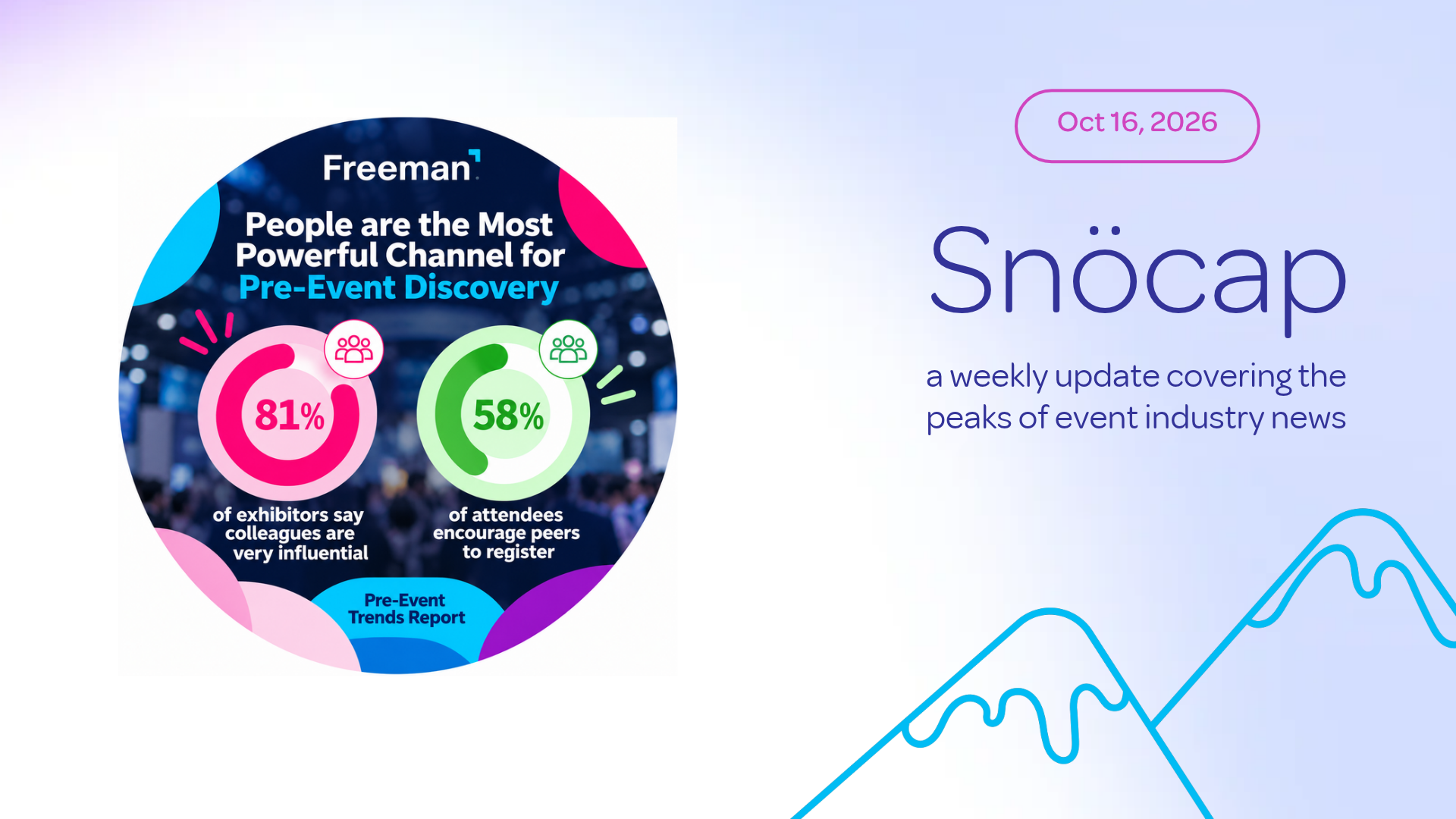
SPOTLIGHT: Word of mouth is still the main way people find events. A Freeman report released by Ken Holsinger at IMEX America 2026 found that colleagues, vendors and professional organizations tie as attendees’ top sources for discovering events, each cited by 45%. Among exhibitors who learned about an event from colleagues, 81% said those colleagues were very or extremely influential in the decision to exhibit.
The report also shows a gap between deciding and registering. Most attendees (84%) decide to attend at least four weeks before they register, yet about half of registrations arrive in the final four weeks before an event. For organizers, that means peer recommendations are shaping attendance long before registration numbers reflect it. Read more below.
Here are the full headlines from this week’s roundup:
- People Remain the Most Powerful Channel for Pre-Event Discovery, Freeman Report Finds
- UK Event Budgets Rise at Fastest Rate in More Than Two Years: IPA Bellwether Report
- GL events Revenue Increases 44.3% YoY in Q3 2026 to Reach €415.9 Million
- Diversified Expands Built Environment Portfolio With Smart Buildings Media Acquisition
- Who Is Hiring?
Get the full stories below:
People Remain the Most Powerful Channel for Pre-Event Discovery, Freeman Report Finds
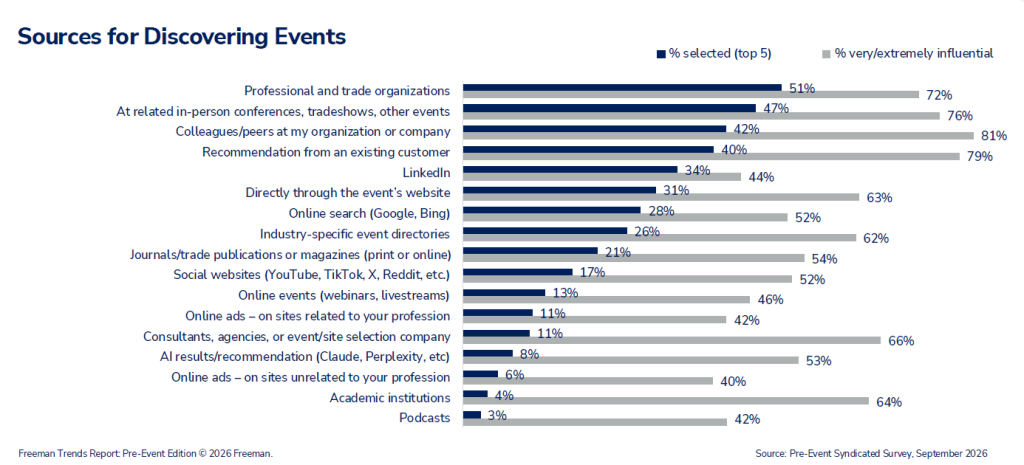
Colleagues, vendors and professional groups are still how most people find events, according to the ‘Freeman Trends Report: The Pre-Event Edition (Q4 2026),’ which Ken Holsinger released at IMEX America 2026. The report also shows that personal networks shape attendance decisions weeks or months before anyone registers.
Freeman surveyed 2,272 attendees and 1,187 exhibitors in September. Three discovery sources tied for first among attendees, each cited by 45%:
- Colleagues within their organization
- Vendors and partners
- Professional and trade organizations
Exhibitors reported the same pattern. Among those who heard about an event from colleagues, 81% said those colleagues were very or extremely influential in the decision to exhibit. For recommendations from existing customers, the figure was 79%.
Advocacy also continues after attendees sign up. Of registered attendees, 58% said they encourage peers to register, usually without an incentive.
The report found that the decision to attend comes well before registration:
- 84% of attendees decide at least four weeks before registering
- 19% decide six months or more in advance
- 40% decide three to five months ahead
- 25% decide four to eight weeks ahead
- 17% register within four weeks of deciding
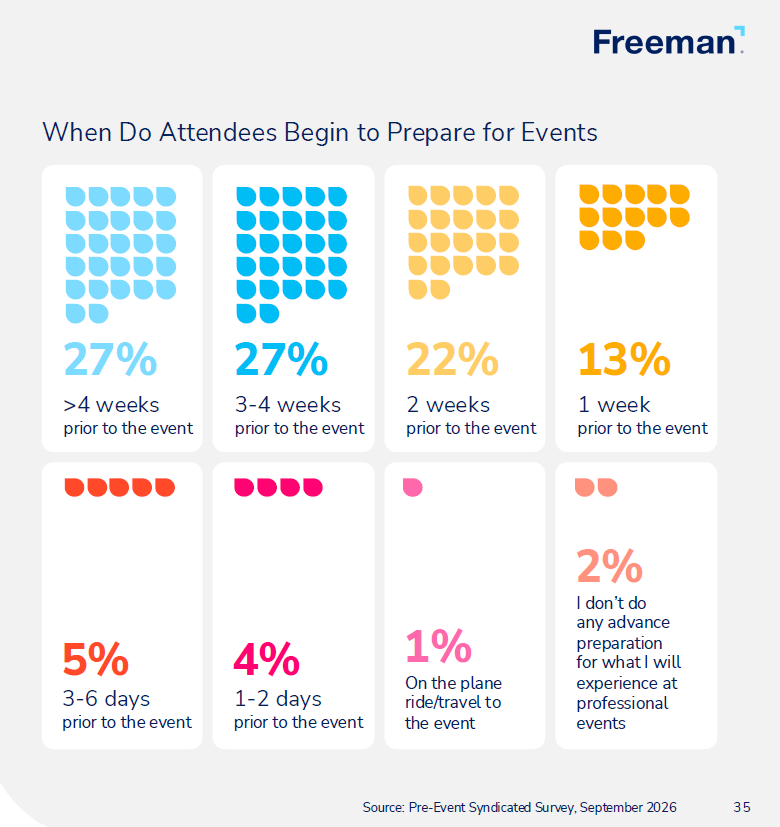
Registrations still cluster late. Campaign data from mdg, Freeman’s agency, shows about half of registrations arrive in the final four weeks before an event. One in five attendees said they would register on-site if needed. Meanwhile, 54% begin planning what to do at an event three or more weeks out.
Attendees recommend events through LinkedIn, email and conversation, and some set up meetings or lunches with the people they invite. They point to networking, speakers, vendors and overall value. Only 18% approve their own event funding. The rest make the case to their organization, most often by citing products and solutions they will discover (46%) and skills they will gain (44%).
Who attends matters more than how many. When asked which attendee information would encourage them to register, 60% chose the types of organizations attending and 45% the names of industry experts and influencers. Only 22% chose attendee numbers.
Fear of missing out plays a moderate or key role for 41% of attendees, while 60% said it plays no role.
Influencers carry weight at several stages. While evaluating an event, 24% of attendees consider what influencers and experts say about it.
Among attendees from the same organization, 46% meet ahead of time to divide up sessions and exhibitors.
AI is also becoming a discovery tool. The survey found 21% of attendees and 25% of exhibitors had used AI to find events, and 82% of those attendees said it helped them narrow their options. Freeman advises organizers to keep event information clear and consistent and to build visibility through LinkedIn, industry media and partners.
The report sets out four steps for event marketers:
- Begin promotion months ahead instead of focusing on the final weeks.
- Give advocates specific reasons to share, such as speaker announcements, exhibitor lists and learning outcomes, along with personalized invitations and ready-to-share content.
- Reward advocates with access, such as VIP experiences, instead of discounts. Since only a quarter of attendees pay their own way, discounts may mainly benefit employers. A quarter of attendees said VIP or early-access perks would get them to register earlier.
- Bring in exhibitors, customers, speakers and partners, who can reach professional networks that organizers cannot.
For organizers, the data points to where event growth will come from. Advertising can buy reach, but the report shows that the decision to attend follows trust between people: a colleague’s suggestion, a customer’s endorsement, an expert’s post. Peer advocacy puts that trust to work. Attendees, speakers, exhibitors and partners invite people from their own networks, and each invitation carries a personal voice that an organizer’s own channels cannot match. Trust-powered, human-to-human marketing is how events will grow from here.
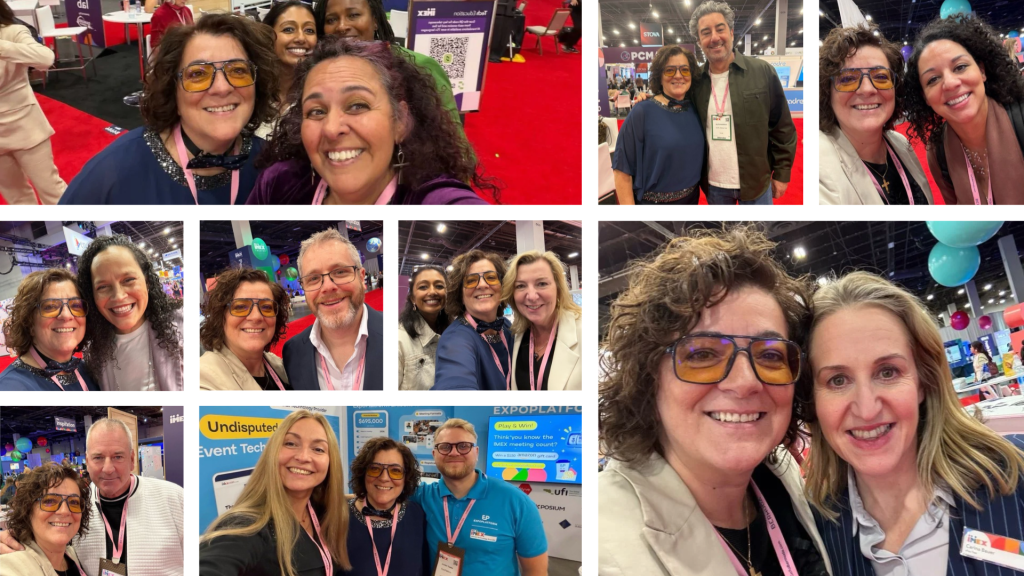
Snöball CEO Rachel Stephan, a longtime advocate of human-to-human marketing and trust-based peer advocacy, spoke at length about this approach at IMEX America 2026, including how it helps organizers bring the right people to their events. If you didn’t get a chance to meet her at the show, connect with Rachel and send her a message. You will learn how organizers and event marketers are using peer-to-peer event marketing to attract the right attendees, increase engagement and build visibility organically, with minimal lift for their teams.
UK Event Budgets Rise at Fastest Rate in More Than Two Years: IPA Bellwether Report
UK companies increased their event budgets at the fastest pace in more than two years in the third quarter, according to the latest Bellwether Report from the Institute of Practitioners in Advertising.
S&P Global Market Intelligence produces the quarterly report for the IPA. It tracks marketing spend plans and financial confidence among a panel of about 300 UK marketing professionals, drawn mostly from the country’s 1,000 largest companies.
The net balance for events is the share of companies raising budgets minus the share cutting them. It reached its highest level in nine quarters:
- +15.1% in Q3 2026, up from +11.0% in Q2
- +14.7% in Q1 2026
- +23.1% in Q1 2024, the category’s record
- PR finished ahead of events in Q3, at a record +15.3%
Events had led every category in the two previous reports.
Spending rose across all marketing. Of the companies surveyed, 25.6% raised their total budgets and 11.3% cut them, for a net balance of +14.3%. That marked the third straight quarter of growth and the largest upward revision since Q2 2024. All seven categories in the report recorded increases, and main media reached a nine-quarter high.
Paul Bainsfair, director general of the IPA, said: “With growth back at the top of the Government’s agenda, it’s encouraging to see businesses increasing marketing investment at the strongest rate in more than two years, underlining advertising’s role as a driver of demand, competitiveness and economic prosperity.”
“It’s particularly encouraging to see upward revisions across every Bellwether category, with main media recording its strongest budget uplift in nine quarters. The sharp rise in sales promotion spending is also understandable as businesses look to drive immediate results. But while promotions have their place, marketers should be wary of becoming hooked on short-term activation. Recent evidence suggests that over-reliance on promotions can erode long-term value.
“In uncertain times, the most successful businesses are those that balance demand capture with demand creation, recognising that an excessive focus on today’s sales can come at the expense of tomorrow’s growth.”
Maryam Baluch, economist at S&P Global Market Intelligence and author of the report, said: “With the UK economy beating expectations so far in 2026, it’s unsurprising to see businesses showing a strong willingness to lift marketing spend.”
S&P Global Market Intelligence has raised its 2026 UK growth forecast to 1.2% from 0.6%, after the economy grew faster than expected in the first half. It attributes part of that growth to the FIFA World Cup and hot weather.
Companies remain cautious about the outlook:
- 34.6% were pessimistic about their industry’s financial prospects
- 14.3% were optimistic
- S&P Global Market Intelligence lowered its forecast for 2027 UK advertising spend growth to 1.3% from 2.3%
GL events Revenue Increases 44.3% YoY in Q3 2026 to Reach €415.9 Million
GL events’ revenue rose 44.3% year over year in the third quarter to €415.9 million, driven by its Live and Venues divisions. The event industry group also raised its full-year guidance.
Results for the first nine months of 2026:
- Revenue: €1,382.2 million, up 17.4% from €1,177.1m
- GL events Live: €790.6m, up 25.1%
- GL events Venues: €434.8m, up 23.9%
- GL events Exhibitions: €156.8m, down 19.3%
The company said the Exhibitions decline reflects the biennial event cycle and weakness in China. International operations accounted for 55% of nine-month revenue, up from 52% a year earlier.
Olivier Ginon, chairman and CEO of GL events Group, said: “GL events confirmed its positive momentum in the third quarter and the strength of its business model, bolstered by strong growth in the Live and Venues divisions and a portfolio of major international events. Our successful work on the Aichi-Nagoya Asian Games, a particularly full events calendar at Stade de France, the quality of our services for Pope Leo XIV’s visit to France and the vitality of our international operations provide concrete illustrations of our organisational capabilities and the dedication of our teams. As a result, despite a challenging global environment, we approach the end of the period with determination and confidence and, with a clearer outlook for the full year, are raising our annual guidance today.”
GL events now expects revenue growth of more than 10% at constant exchange rates and scope of consolidation for 2026, along with growth in current operating income. It plans capital expenditures of about €80 million.
The company has also won a 15-year contract to operate the Lima Convention Center in Peru, which it expects to generate more than €12 million in annual revenue once fully operational.
Diversified Expands Built Environment Portfolio With Smart Buildings Media Acquisition
Diversified UK & Europe has acquired Smart Buildings Media Limited, adding an event and two digital publications on smart buildings to its built environment portfolio.
The deal includes Smart Buildings Show, an annual event at ExCeL London, along with Smart Buildings Magazine and Smart Infrastructure Magazine. The publications reach tens of thousands of subscribers each month. Diversified’s portfolio in the sector already includes Digital Construction Week and GEO Business.
Smart Buildings Show draws professionals from energy management, IT and digital infrastructure, property technology and building controls. Its most recent edition ran Oct. 14-15.
Beginning in 2027, the show will be co-located with Digital Construction Week and GEO Business at ExCeL London on June 23-24. It will keep its own entrance and branding. Diversified gave these figures for the shows:
- Smart Buildings Show: more than 100 exhibitors and 3,500 visitors
- All three co-located events: more than 350 exhibitors and 15,000 visitors
John Hatcher, co-owner, editor and conference director of Smart Buildings Media, and sales manager Claire Hatchett will join Diversified UK & Europe.
Carsten Holm, managing director of Diversified UK, said: “We have always been impressed by the focus and subject matter of Smart Buildings Show, Smart Buildings Magazine and Smart Infrastructure Magazine. This acquisition is a strong fit with what we already do as a successful, growing organiser. Bringing the show alongside Digital Construction Week and GEO Business lets us give it real scale while keeping its own distinct identity. We’re looking forward to working with Claire, John and the exhibitor community – listening to their ideas and making sure the event continues to reflect the needs of the industry.”
John said: “These are exciting times in the smart buildings industry and Diversified’s acquisition of Smart Buildings Show is a reflection of how the sector has grown. Diversified will be able to take the event to the next level and by locating alongside Digital Construction Week and GEO Business bring a new audience to the smart buildings community. Claire and I are looking forward to joining a successful team.”
Oakley Dyer, chief corporate development officer at Diversified, said: “Diversified UK & Europe continues to strengthen its position as one of the most successful tradeshow organisers in the UK with several recent acquisitions and a series of new launches. We continue to look for strategic acquisition opportunities, both in the UK and Europe and across the other regions where Diversified operates.”
Who is hiring?
Hyve Group| Conference Producer, CWIEME
Profound | Event Marketer
Clarion Events, North America | Event Operations Manager
EventMobi | Director of Global Event Marketing
Coach | Manager, Global Events
Mastercard | Production Manager, Strategic Events